Most homeowners think about their HVAC system twice a year: when it stops working in July, and when the heat kicks on for the first time in November and smells like it is burning dust. That is not a maintenance plan; that is just reacting to problems after they happen.
Living in Nassau County raises the stakes considerably. The coastal climate, the older housing stock, and Long Island’s steep electric rates mean your equipment works harder and costs more whenever it runs below peak efficiency. We built this seasonal calendar for your specific local conditions rather than a generic national audience. Here is what to do, and precisely when to do it.
Why Nassau County Homeowners Can’t Afford To Skip HVAC Maintenance
Only 43% of American homeowners schedule regular HVAC maintenance, and that percentage is likely lower across Long Island, where many assume the system is fine until it stops blowing air. However, units receiving routine attention last roughly 40% longer and are 95% less likely to fail without warning.
For Nassau County specifically, those figures directly affect your wallet. PSEG Long Island electricity rates rank among the highest in the continental United States. An inefficient system does not simply wear out sooner; it inflates your electric bill every single billing cycle it struggles to keep up. Heating and cooling already make up roughly half of typical residential energy use. When coils get dirty, ductwork leaks, or motors lose calibration, that percentage climbs fast.
How Salt Air From The South Shore Affects Your HVAC System
Generic HVAC guides almost always overlook coastal corrosion, yet it represents one of the most critical maintenance factors for communities across our service area, including Lynbrook, Rockville Centre, Oceanside, Baldwin, East Rockaway, Merrick, and Bellmore.
Salt-laden air blowing inland from the Atlantic Ocean and South Shore bays travels miles past the immediate shoreline, settling onto outdoor condenser coils, electrical terminals, and metal cabinets. Over time, that salt film speeds up galvanic corrosion in ways inland markets never experience. An outdoor condensing unit rated to last 15 years in central New Jersey can easily begin deteriorating within eight years along the South Shore without dedicated care.
This means outdoor equipment along the coast requires more frequent attention than standard annual guidelines recommend. Aluminum fins require thorough washing to remove caustic salt film, not just a casual spray for leaves and grass clippings. Electrical contacts need early inspection to prevent corrosion from causing sudden compressor failure.
These realities come from years of hands-on service inside Nassau County neighborhoods. The fall maintenance window, just before you power down the air conditioner for the winter, is a vital time to wash the outdoor unit so corrosive salt residue does not bake into metal surfaces over the cold months.
If your home sits within a few miles of South Shore bays or the ocean, mention your location when scheduling service so our technicians can pay special attention to coil protection.
The Two Maintenance Windows Most Nassau County Homeowners Miss
HVAC contractors see their biggest call spikes during midsummer and midwinter, when equipment breaks down under heavy strain and frantic homeowners need emergency help. The most valuable windows to book service, however, are spring and fall, when mild temperatures keep equipment demand low.
Spring, running from March through May, is the ideal window to evaluate and tune your air conditioning before cooling season begins. Checking refrigerant levels, cleaning coils, measuring airflow, and testing thermostat calibration during mild weather ensures our technicians have full schedule flexibility to address any concerns. By mid-June, HVAC companies across Long Island are fully booked with emergency calls, meaning a breakdown during the first heat wave could leave your family waiting days for service.
Fall, spanning September through November, offers the same strategic advantage for your heating system. Boilers, heat pumps, and furnaces all require thorough safety checks before freezing weather sets in. September is an exceptional window because temperatures are warm enough to run final cooling performance checks while leaving ample time to address burner assemblies or heat exchangers before the first hard frost.
Winter temperatures across Nassau County regularly fall below 16°F. That is the worst moment to discover your boiler skipped maintenance for three seasons. Homeowners who schedule during shoulder seasons rarely deal with emergency shutdowns, while those who wait until equipment fails are the ones calling for late-night service in January.
Summer and winter still require homeowner attention. Replacing air filters every one to three months, clearing shrubbery away from outdoor units, and monitoring your monthly energy bills for unexpected spikes keep equipment protected between technician visits. Still, the two seasonal professional checkups deliver the greatest long-term protection.
What To Expect From A Professional HVAC Tune-Up In Nassau County
A genuine HVAC tune-up goes far beyond a technician glancing at your cabinet and handing you an invoice. It is a comprehensive diagnostic review of how your equipment functions under load, confirming proper performance rather than just verifying that it turns on.
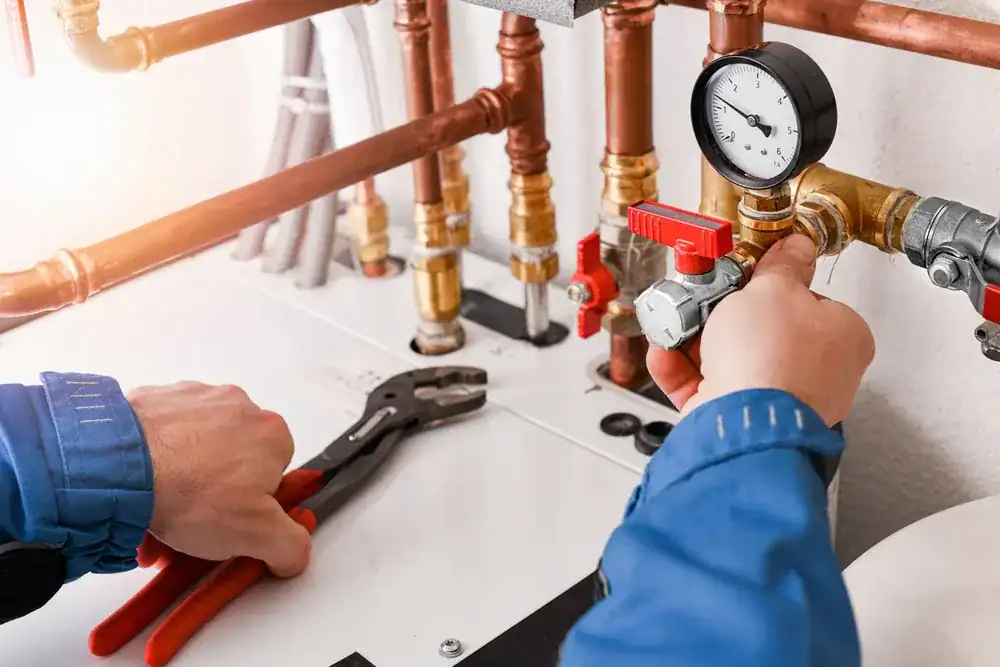
For cooling season tune-ups, our technicians check refrigerant charge, clean indoor evaporator and outdoor condenser coils, test duct static pressure, inspect electrical contacts and capacitors, verify thermostat accuracy, and confirm your system matches your home’s cooling demand. For heating tune-ups, we apply the same attention to your boiler, heat pump, or furnace by testing heat exchangers for safety, inspecting burner flame characteristics, checking exhaust venting, and measuring total operational efficiency.
How To Know If Your HVAC System Needs Repair Or Replacement
Weighing a repair against a full replacement is a tough decision, and it is where many contractors lose trust by pushing a premature replacement or continuously patching a unit that has reached the end of its life.
The right path depends on equipment age, overall reliability, and the repair quote compared to remaining system life. A dependable rule of thumb states that if a repair approaches half the investment of a modern system and the equipment exceeds ten years of age, upgrading is usually the better financial move. With approximately 102 million central systems in the U.S. surpassing ten years of service, Nassau County’s historic housing stock includes a vast number of aging units.
Energy consumption plays an equally critical role. An aging system struggling through summer draws substantially more electricity than a modern, properly configured unit. Given PSEG Long Island utility pricing, that efficiency gap represents significant money. Department of Energy studies show routine maintenance saves 5% to 20% on annual energy use, and upgrading an obsolete system increases those monthly savings even further.
You deserve a straightforward explanation detailing the mechanical fault, the exact repair cost, and an honest projection of the unit’s remaining lifespan. Our NATE-certified technicians give Lynbrook and Nassau County homeowners clear guidance without aggressive sales pitches or confusing pricing surprises.
Why Uneven Heating And Cooling Is So Common In Nassau County Homes
If your second floor feels ten degrees warmer than your ground floor in July, you are not alone; it is one of the most common issues reported by Nassau County residents, and it can almost always be corrected.
The architectural styles defining local neighborhoods, including the classic Cape Cods, split-levels, and colonials constructed between the 1940s and 1970s, were planned around legacy heating equipment rather than modern central air. Duct layouts designed decades ago rarely push air evenly into upper bedrooms or rear additions, resulting in sweltering upstairs rooms in summer and chilly drafts in winter.
Several solutions can resolve these airflow imbalances depending on your home layout. Static pressure adjustments and duct sealing often improve room-to-room comfort without major remodeling. Electronic zone dampers offer a complete solution by giving separate levels independent thermostat control. Ductless mini-split heat pumps provide another effective approach, delivering dedicated comfort to finished basements, converted attics, or sunrooms without stressing your primary ductwork.
Persistent temperature swings do not have to be tolerated. Neighborhoods along the Southern State Parkway, from Valley Stream through Lynbrook and Rockville Centre, encounter these distribution issues frequently due to post-war framing styles. Having our team evaluate your duct pressure and register airflow pinpoints the true bottleneck so you stop fighting your thermostat.
Finding Reliable HVAC Services In Nassau County That Show Up
Maintaining your comfort year-round comes down to a simple rhythm: spring service for your air conditioner, fall service for your heat, and regular filter changes in between. The essential step is partnering with a dependable team that arrives on schedule, diagnoses problems honestly, and charges transparent rates. Backed by NATE-certified technicians, an A+ Better Business Bureau rating, and over 142 five-star Google reviews, COOL BROS CORP delivers dependable service across Lynbrook and all of Nassau County. Contact COOL BROS CORP today to schedule your seasonal HVAC tune-up and keep your home comfortable through every season Long Island brings.