You called someone. They came out, replaced a part, and told you the problem was fixed. Then two weeks later — or two months later, right when a cold front moved in — your heat stopped working again. Same symptoms. Different bill.
This is more common than most people realize, and it’s not always about dishonesty. A lot of heating repair misdiagnosis comes down to how the technician approaches the problem in the first place. If they’re chasing symptoms instead of causes, you’ll keep paying for repairs that don’t hold.
Here’s what’s actually going on — and what the right diagnosis looks like.
Why Heating Systems Get Misdiagnosed in the First Place
Heating systems fail in ways that look identical on the surface but have completely different root causes underneath. A furnace that won’t stay on could be a dirty flame sensor, a failing thermostat, a clogged condensate drain, or a collapsed return duct — and if the technician doesn’t work through the possibilities systematically, they’ll fix the most obvious-looking thing and leave.
The industry has a structural problem here. There’s a national shortage of roughly 110,000 qualified HVAC technicians, which means a lot of people doing this work aren’t doing it at the level they should be. Equipment prices have also gone up about 40% since 2020, which puts pressure on technicians to move fast and close jobs quickly. Neither of those things is good for diagnostic accuracy.
The result is a lot of homeowners in Nassau County paying for repairs that don’t solve anything — and not knowing why.
The Dirty Flame Sensor Problem: The Most Misdiagnosed Furnace Issue
If your furnace lights, runs for a few seconds, then shuts off — and keeps doing that — a dirty flame sensor is almost always the first thing worth checking. It’s the single most common cause of furnace lockouts, and it’s one of the most frequently mishandled repairs in the industry.
Here’s what happens: the flame sensor is a small metal rod that confirms the burner actually lit. Over time, oxidation builds up on the surface of that rod and prevents it from reading the flame correctly. The furnace thinks there’s no flame, shuts down as a safety measure, and the cycle repeats. The fix — cleaning the sensor with fine emery cloth — takes minutes and costs almost nothing.
The misdiagnosis happens when a technician skips straight to replacing the sensor, or worse, replaces the control board because the symptoms looked like an electrical issue. Neither of those fixes addresses why the sensor oxidized in the first place. If there’s an underlying issue with combustion airflow or the sensor’s position, the new part will fail the same way the old one did.
This is exactly the kind of situation where experience and a structured diagnostic process make the difference. A technician who checks airflow and combustion conditions before reaching for a replacement part will find the real cause. One who goes straight to parts will leave you in the same place — just a few hundred dollars lighter.
Nassau County homes add a layer of complexity here. A significant portion of the housing stock was built in the postwar boom of the 1940s through 1960s, which means older ductwork, non-standard configurations, and systems that have been modified over decades. What looks like a simple furnace problem in a newer home can be a much more layered diagnostic challenge in a house that’s been through five different owners and three different heating systems.
Why Refrigerant Top-Offs and Thermostat Replacements Don’t Always Fix the Problem
Two of the most common “quick fixes” in heating repair — topping off refrigerant and swapping out the thermostat — are also two of the most likely to leave the underlying problem untouched.
Start with refrigerant. This one matters most for heat pumps, which are becoming increasingly common in Nassau County, NY as homeowners move away from oil heat. Refrigerant doesn’t deplete on its own. If your heat pump is low on refrigerant, there is a leak somewhere in the system. Recharging without finding and sealing that leak is a temporary fix — the refrigerant will drop again, and repeated recharging puts real stress on the compressor. Eventually, you’re not looking at a repair anymore. You’re looking at a replacement. A proper heat pump repair finds the leak first, seals it, and then recharges the system to the correct level.
The thermostat situation is a little different. Thermostats do fail, but they also get blamed for problems they didn’t cause. A thermostat mounted near a drafty window, a sunny wall, or a heat-producing appliance will misread the room temperature and cause the system to short cycle or run longer than it should. That’s not a thermostat malfunction — it’s a placement problem. Swapping in a new thermostat without addressing placement means the new one will behave exactly the same way.
There’s also the issue of thermostat calibration drift. Over time, the temperature sensor inside a thermostat can lose accuracy. The fix is recalibration, not replacement. A technician who evaluates the thermostat’s placement, wiring, and calibration before recommending a new unit is doing the job correctly. One who replaces it on instinct is guessing.
Both of these scenarios — the refrigerant top-off and the thermostat swap — feel like real repairs in the moment. The technician came out, did something, and charged you for it. But if the root cause wasn’t addressed, you’ll be back on the phone within a season.
What a Proper Heating Repair Diagnosis Actually Looks Like
A correct diagnosis starts with airflow — not parts. Before a technician touches any component, they should be checking whether air is actually moving through the system the way it’s supposed to. Filters, ductwork, vents, and return air pathways all need to be evaluated first. Skipping this step and jumping straight to electrical or refrigerant checks is how a collapsed return duct gets missed for three hours while the technician chases a ghost.
From there, a structured diagnostic works outward — from the simplest and most common causes toward the more complex ones. Thermostat settings and calibration, ignition and flame sensing, heat exchanger condition, refrigerant levels (and leak detection if levels are low), electrical components. Each step builds on the last.
The technician’s job is to find the cause, not just the symptom. Those are often two different things.
How Ductwork Problems Get Overlooked During Heating Repairs
Ductwork is one of the most consistently overlooked parts of a heating repair diagnosis, partly because it’s hidden and partly because the system still runs even when ducts are compromised.
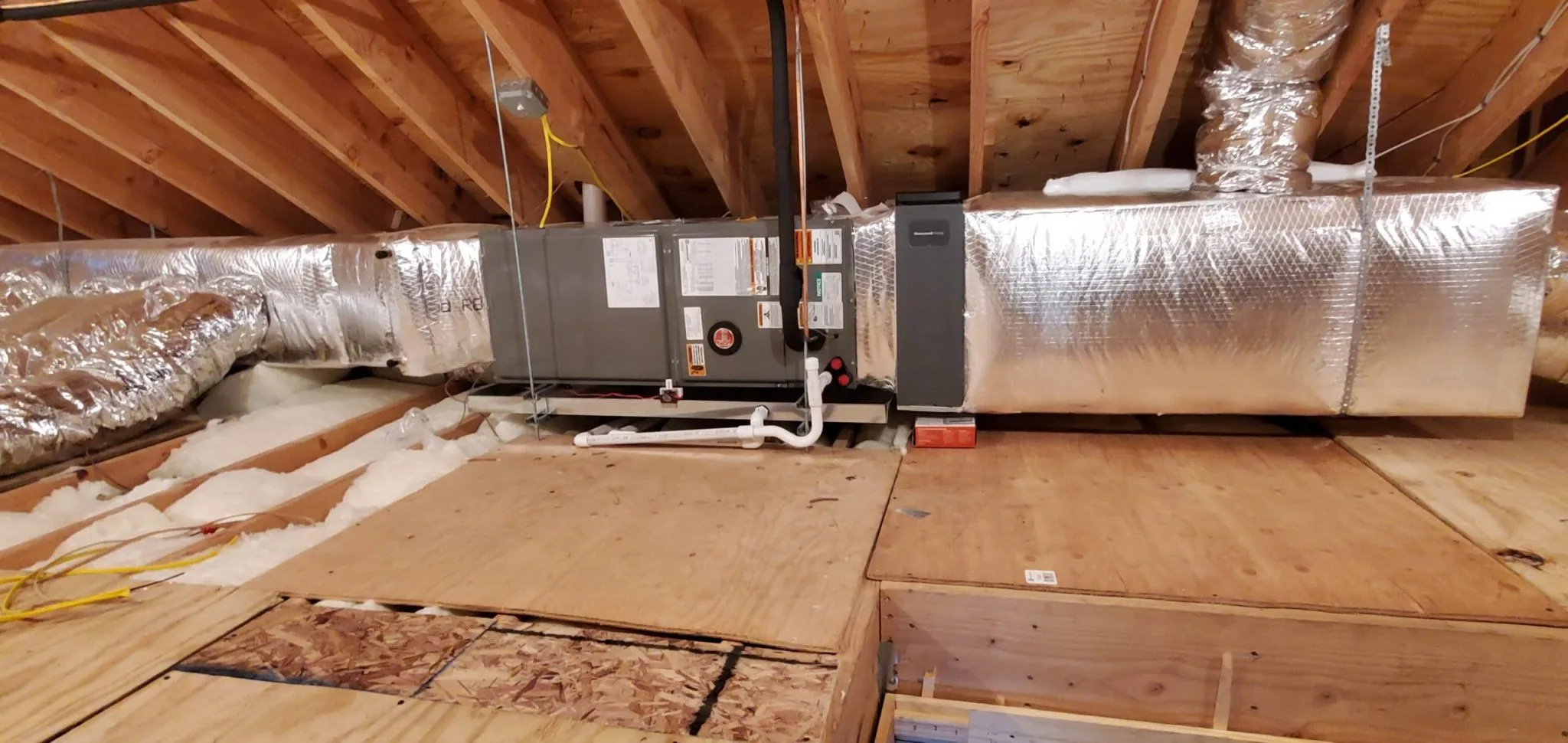
A collapsed return duct is a good example. The furnace fires, air moves, the system appears to be working — but the house never gets warm because a significant portion of the conditioned air is escaping into an attic or crawl space before it reaches the living areas. The homeowner calls for a repair. The technician checks the furnace, finds nothing obviously wrong with the unit itself, and closes the job. The house is still cold.
This scenario plays out regularly in older homes. In Nassau County, where a lot of the residential housing stock predates modern duct design standards, ductwork issues are genuinely common. Joints separate. Insulation degrades. Flexible duct collapses under its own weight if it wasn’t installed with proper support. None of this is visible from the furnace room, which is why a thorough diagnostic has to include the full duct system — not just the equipment.
Structured troubleshooting that starts with airflow would catch a duct problem in minutes. Troubleshooting that skips airflow and goes straight to components can miss it entirely, even after hours of work. The difference isn’t about how long the technician spends — it’s about the order in which they check things. A technician who follows a logical diagnostic sequence will find duct problems early. One who doesn’t may never find them at all.
What to Look for in a Heating Repair Technician in Nassau County
Credentials matter more than most homeowners realize — not because a piece of paper makes someone a good technician, but because the process of earning those credentials forces a level of knowledge that translates directly into better diagnostics.
NATE certification (North American Technician Excellence) is the most credible third-party competency standard in the industry. NATE-certified technicians have passed rigorous knowledge-based exams covering specific system types. It’s not a formality — it’s a meaningful signal that the person working on your system understands how it actually works.
Manufacturer authorization matters for similar reasons. A technician who is factory-trained on Mitsubishi systems, for example, has learned those systems at the component level — not just from general HVAC training. That’s the difference between a technician who recognizes a Mitsubishi-specific fault code and one who has to guess. It also matters for warranties: unauthorized repairs on a system still under manufacturer warranty can void coverage entirely.
In Nassau County specifically, you want someone who knows the local housing stock. The mix of postwar single-family homes, older boiler systems, homes converting from oil to gas or heat pumps, and the coastal humidity that accelerates corrosion in HVAC components — these are real factors that affect diagnosis. A technician who’s been working in Nassau County for years will have seen these patterns before. One who hasn’t may not know what they’re looking at.
Beyond credentials, pay attention to how the technician communicates. Do they explain what they found and why? Do they give you a written price before starting work? Do they tell you what they checked, not just what they’re replacing? Transparency in communication is often the best real-world indicator of whether a technician is diagnosing or guessing. If they can’t explain the cause clearly, there’s a reasonable chance they haven’t actually found it.
Getting Your Heating Repair Right the First Time
Misdiagnosed heating repairs aren’t just frustrating — they’re expensive, and they compound over time. Every wrong fix delays the right one, puts additional stress on system components, and leaves you one cold night away from the same problem all over again.
The answer isn’t to distrust every technician. It’s to understand what a proper diagnostic process looks like, know which credentials actually matter, and ask the right questions before anyone starts working. A technician who checks airflow first, explains their findings clearly, and gives you a written price upfront is doing the job the right way.
If your heat keeps failing after repairs — or you want it diagnosed correctly before the next cold snap hits — we’re here to help. Our team serve all of Nassau County from our Lynbrook location. Reach out and we’ll take a look at what’s actually going on.