It’s the middle of July. Your AC is running — you can hear it, the fan is blowing — but the air coming out of the vents is warm. Maybe lukewarm. Definitely not cold. And the house is climbing toward 80 degrees while you’re standing there wondering what just broke.
This is one of the most common and most confusing AC problems homeowners in Nassau County, NY deal with every summer. The good news is that not every cause is a major repair. Some of them you can check and fix yourself in five minutes. Others genuinely need a licensed technician. Knowing the difference is the whole point of this guide.
My AC Is Not Cooling — Start With These Checks Before Calling Anyone
Before assuming the worst, there are a few things worth checking on your own. Not because we’re trying to talk you out of calling a professional — but because a surprising number of “my AC stopped working” calls turn out to be a clogged filter or a thermostat set to the wrong mode. These are things you can confirm in under ten minutes.
Start with your air filter. A filter that’s been in place for more than 60 to 90 days — especially during heavy summer use — can get clogged enough to restrict airflow so severely that the system can’t cool effectively. Pull it out and hold it up to the light. If you can’t see through it, replace it. It’s a $10 fix that sometimes solves the whole problem.
Next, check your thermostat. Make sure it’s set to “cool” and not “heat” or “fan only.” It sounds obvious, but the “fan only” setting will blow air through your vents without actually running the cooling cycle — which means you get airflow, but no cold air. Also confirm the temperature is set lower than whatever the house currently reads.
Air Conditioner Not Blowing Cold Air But Running — What That Actually Means
This is the scenario that confuses people the most, and for good reason. If the system is clearly on, the fan is moving air, and you can hear the outdoor unit running — but the air coming out of your vents is warm — that’s a different kind of problem than an AC that simply won’t turn on. The system is working in the sense that it’s powered and running, but something is preventing the refrigerant cycle from doing its job.
One of the most common causes is a frozen evaporator coil. The evaporator coil sits inside your air handler and is responsible for absorbing heat from the air in your home. When airflow is restricted — usually from a dirty filter or a blocked return vent — or when refrigerant levels drop, the coil can get so cold that moisture freezes around it. Once it’s encased in ice, it can’t absorb heat at all, and the air coming through your vents stays warm even though the system is technically running.
If you suspect a frozen coil, turn the system off and let it thaw completely — this can take several hours. Do not try to chip the ice off. Once it’s thawed, check your filter and make sure all your vents and return grilles are open and unobstructed. If the coil freezes again after you restart the system, that’s a sign of a deeper problem — likely low refrigerant — and it’s time to call a technician.
Low refrigerant is another common reason an AC runs without cooling. Here’s something a lot of homeowners don’t realize: refrigerant doesn’t get “used up” the way gas does in a car. If your system is low on refrigerant, it means there’s a leak somewhere in the system. Simply recharging the refrigerant without finding and fixing the leak is a temporary fix — it’ll just leak out again. Refrigerant also can’t be handled without EPA Section 608 certification, so this is not a DIY repair under any circumstances.
Nassau County’s coastal humidity plays a real role here too. The proximity to Long Island Sound and the Atlantic means summer air here carries significantly more moisture than inland areas. That added humidity puts extra strain on evaporator coils and refrigerant systems, which is part of why frozen coil issues and refrigerant-related problems show up more frequently on Long Island than homeowners might expect.
Could Your Outdoor Unit or Ductwork Be the Problem?
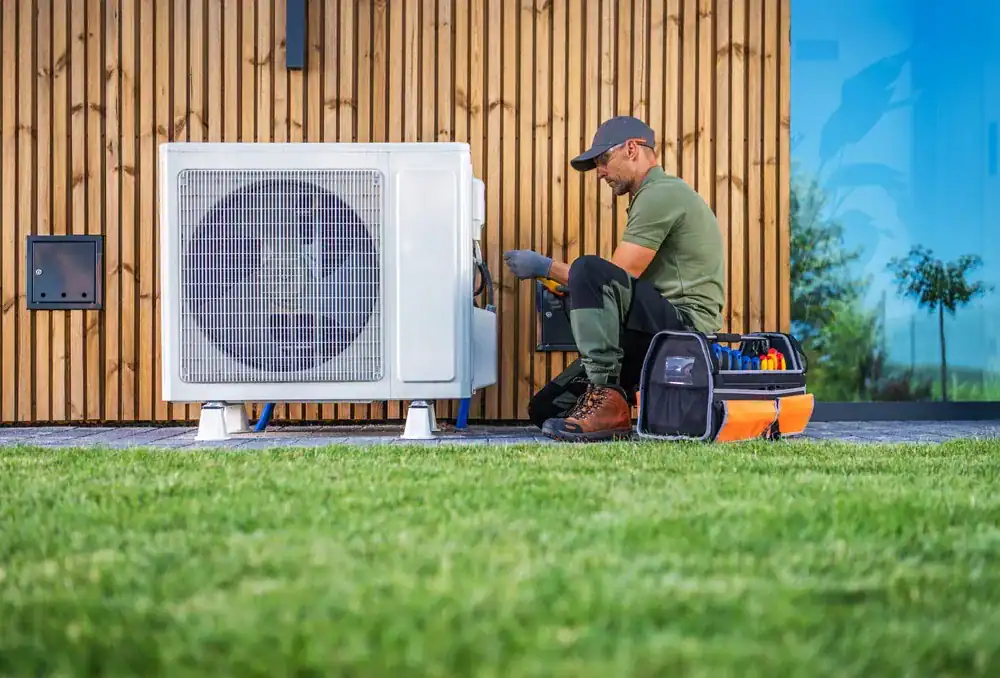
A lot of people focus entirely on the indoor unit when their AC isn’t cooling, but the outdoor condenser unit is just as important — and it’s often overlooked. The condenser is responsible for releasing the heat your system pulls out of your home. If it’s blocked by debris, overgrown shrubs, or a buildup of dirt and grime on the coils, it can’t do that job efficiently. The result is an AC that runs constantly but never quite gets the house to temperature.
Take a look at your outdoor unit. Make sure there’s at least two feet of clearance around it. If the fins on the outside of the unit look caked with dirt or debris, that’s worth noting when you call for service — we can clean the coils as part of a tune-up, and it makes a noticeable difference in performance.
Ductwork is another factor that doesn’t get enough attention, particularly in Nassau County’s older housing stock. A significant portion of homes here were built between the 1940s and 1970s, and many of them still have their original ductwork — or ductwork that hasn’t been inspected in decades. Leaky ducts can allow conditioned air to escape into your walls, attic, or crawl space before it ever reaches your living areas. The result feels like your AC isn’t cooling, even when the unit itself is functioning perfectly. Some rooms stay comfortable while others stay stubbornly warm, and the thermostat never seems satisfied.
There’s also a less commonly known culprit: the condensate drain pan safety switch. Your indoor unit produces condensation as it cools the air, and that moisture drains out through a condensate line. If that line gets clogged — which happens more often during Nassau County’s humid summers — the drain pan fills up and a safety switch automatically shuts the system down to prevent water damage. If your AC suddenly stops cooling and you notice water pooling near the indoor unit, this is likely what happened. We can clear the drain line quickly, but it’s not something most homeowners should attempt without knowing where the components are.
Central Air Not Cooling Your Whole House — When It’s More Than a Simple Fix
Sometimes the problem isn’t that the AC has stopped working entirely — it’s that it’s working for some parts of the house and not others. One room is comfortable, another is unbearable. The system runs constantly but can’t bring the temperature down to where you’ve set it. This pattern points toward a different set of causes than a complete cooling failure, and it usually means the issue is either with the distribution of air or with the capacity of the system itself.
If your central air has been keeping up fine for years and suddenly can’t cool the house, something has changed — either with the system, the home, or both. That’s the starting point for figuring out what’s actually going on.
Why Is My AC Running Constantly But the House Won’t Cool Down?
When an AC runs all day without bringing the house to temperature, it’s almost always one of three things: the system is undersized for the space it’s trying to cool, something is forcing it to work harder than it should, or it’s losing cooling capacity due to age or a developing mechanical issue.
Undersized equipment is more common than people realize, especially in Nassau County homes that have been renovated or had additions built since the original HVAC system was installed. A system sized for 1,400 square feet will struggle badly in a home that’s now 1,900 square feet. If your system has always seemed to run long and struggle on hot days, sizing may be the underlying issue.
Heat gain is the other major factor. On a day when temperatures hit 90°F or above — which happens regularly on Long Island through July and August — an older, lower-efficiency system may simply not have the capacity to overcome the heat load. Poorly insulated attics, west-facing windows without shading, and older single-pane glass all contribute to heat entering the home faster than the system can remove it.
If the system is relatively new and well-sized but still struggling, the problem is more likely mechanical — a refrigerant issue, a failing compressor, or a blower motor that isn’t moving air at the right speed. These aren’t things you can diagnose from the outside. We’ll need to check refrigerant pressure, measure airflow, and evaluate the electrical components to identify where the system is losing efficiency.
One thing worth knowing: if your home has a system manufactured before 2010, it almost certainly uses R-22 refrigerant, which was fully phased out as of January 1, 2020. R-22 is no longer being produced, and while existing supplies can still be used for service, the cost has risen significantly. If an older system develops a refrigerant leak, the repair conversation often turns quickly into a replacement conversation — and that’s not a bad thing, given how much more efficient current systems are compared to what was being installed fifteen or twenty years ago.
Should You Repair or Replace an AC That’s Not Blowing Cold Air?
This is the question that makes most homeowners anxious, and understandably so. A repair feels manageable. A replacement feels like a major decision. But the answer is usually less complicated than people expect once you have the actual diagnosis in front of you.
The general rule of thumb in the HVAC industry is to consider replacement when the repair cost exceeds roughly half the cost of a new system, especially if the system is more than ten years old. A well-maintained system can last fifteen to twenty years, but after the ten-year mark, the likelihood of additional failures increases — and you’re often paying to keep an inefficient system running when a new one would cost less to operate.
Current American Standard systems — which we install and service — reach up to 22.0 SEER2 efficiency, which is significantly above the current federal minimum of 13.4 SEER2 for the Northern region. High-efficiency systems can generate $840 or more in annual energy savings compared to older, lower-rated equipment. Over five to ten years, that adds up to real money — and that’s before factoring in PSEG Long Island rebates on qualifying ENERGY STAR systems or federal tax credits of up to $2,000 for eligible heat pump installations.
If you’re on the fence, the most useful thing you can do is get an honest assessment from our team. We’ll give you the actual numbers — repair cost, expected remaining lifespan, efficiency comparison — and let you make the decision with full information. That’s how we approach every service call. We’ll tell you what we found, what it will take to fix it, and what a replacement would look like if that’s the better path. No pressure in either direction.
For Nassau County homeowners with systems that are aging but still functional, pre-season maintenance is genuinely worth doing — not because it’s a sales pitch, but because a system that gets caught before a failure in May is far less stressful than one that fails on a Saturday in late July when every HVAC company in the county has a full schedule and heat wave response times stretching to 24 hours or more.
AC Still Not Blowing Cold Air? Here’s What to Do Next
If you’ve checked the filter, confirmed the thermostat settings, looked at the outdoor unit, and the system is still blowing warm air — you’ve done what you can do safely on your own. The next step is getting a licensed technician in to diagnose what’s actually happening, whether that’s a refrigerant issue, a frozen coil, a failing component, or something with your ductwork.
The earlier you call, the better. Nassau County summers don’t leave much margin for waiting, and a system that’s struggling now will only get worse as temperatures climb. We offer same-day service and true 24/7 emergency availability — nights, weekends, and holidays — because we know comfort in this county doesn’t run on a nine-to-five schedule.
If you’re ready to get answers and get your home cooling again, reach out to COOL BROS CORP. We’re based in Lynbrook and we serve all of Nassau County, NY. We’ll give you a straight diagnosis, upfront pricing, and a clear path forward — whatever that looks like for your situation.