It’s the middle of July. Your house is 82 degrees, the humidity is thick, and your AC is either doing nothing or doing something that isn’t cooling. You’re not sure if it’s a quick fix or a thousand-dollar problem — and the last thing you want is to call a company that’s going to tell you everything is broken whether it is or not. That frustration is completely fair. This guide is built around one idea: understand what’s wrong before you commit to anything. We’ll walk you through the most common causes, what you can check yourself, and when you genuinely need a pro.
AC Not Blowing Cold Air? Start Here Before Anything Else
The most common AC complaint isn’t a dead system — it’s a system that seems to be running but isn’t actually cooling the house. The fan is on, the unit is humming, but the air coming out of your vents is room temperature at best. Before you assume the worst, there are a few things worth checking that cost nothing.
First, look at your thermostat. Make sure it’s set to “Cool” and not just “Fan” — when the fan setting is switched to “ON” instead of “AUTO,” the system circulates air continuously even when it isn’t actively cooling. It’s a small thing, but it’s also one of the most common reasons a house stays warm. Second, check your air filter. A clogged filter restricts airflow so severely that even a perfectly functioning AC can’t do its job. If yours looks gray and packed with dust, swap it out and give the system 20–30 minutes to recover before drawing any conclusions.
What Does a Frozen Evaporator Coil Look Like — and What Causes It?
If you’ve checked the thermostat and filter and the system still isn’t blowing cold air, the next thing to look for is ice. Go to your indoor air handler — usually in a utility closet, attic, or basement — and look at the copper lines running into it. If you see frost or actual ice buildup, your evaporator coil is frozen, and that’s why the air isn’t cold.
A frozen coil is one of those problems that looks alarming but often has a straightforward cause. Restricted airflow is the most common culprit — that same dirty filter you might have just changed, or supply vents that are closed or blocked by furniture. When airflow drops too low, the coil gets too cold and freezes over. The refrigerant inside can’t absorb heat properly, so the air coming out stays warm even though the system is technically running.
The fix for a frozen coil starts with turning the system off and letting it thaw completely — usually a few hours. Run the fan on its own to speed that up if your thermostat allows it. Once it’s thawed, replace the filter if you haven’t already, make sure all your supply vents are open and unobstructed, and restart the system. If it freezes again within a day or two, you’re likely looking at low refrigerant — and that’s where DIY ends.
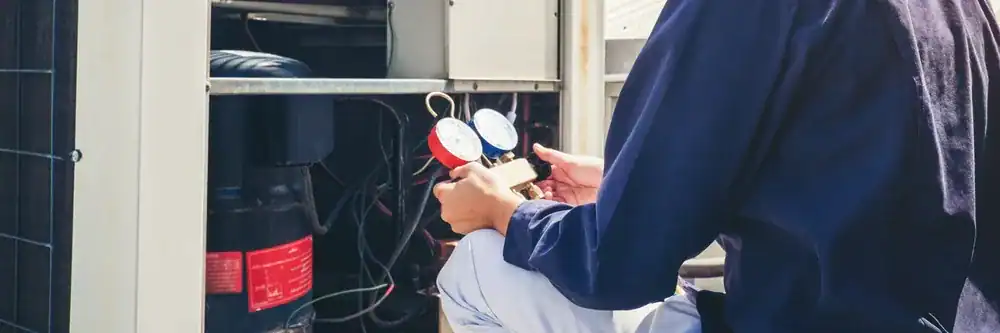
Refrigerant isn’t something you can legally top off yourself. Under federal law, refrigerants may only be purchased and handled by EPA-certified technicians. More importantly, low refrigerant always means there’s a leak somewhere. Adding more without finding and fixing the leak just delays the problem. A licensed technician needs to locate the leak, repair it, and then recharge the system to the correct level. It’s not a glamorous repair, but it’s a necessary one.
Nassau County Homes and the AC Problems That Come With Them
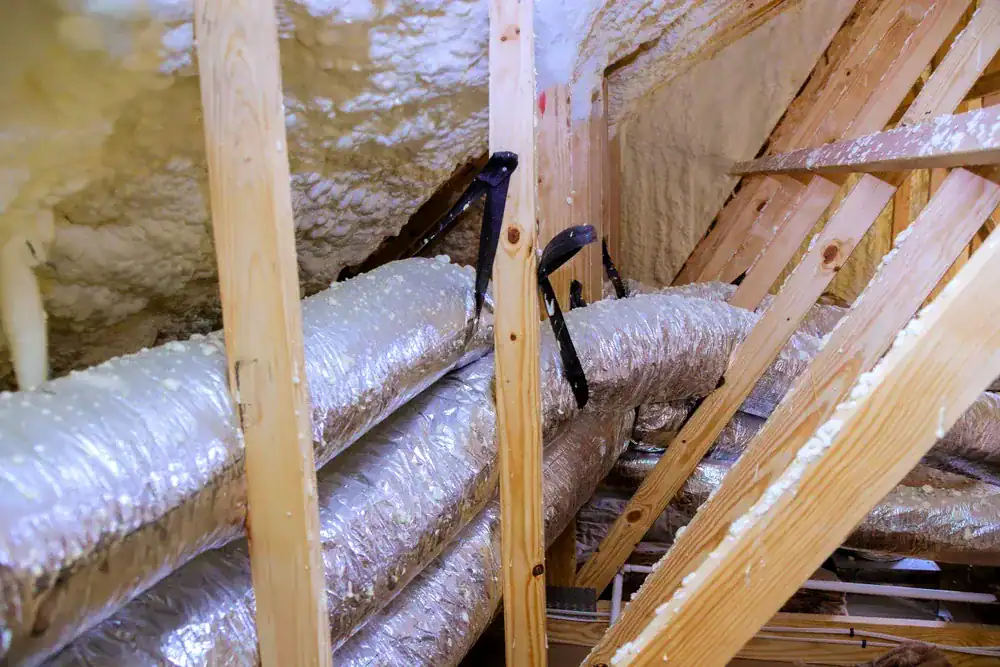
Here’s something worth knowing if you live in Nassau County, NY: your home probably wasn’t designed with modern air conditioning in mind. A large portion of the housing stock across communities like Lynbrook, Rockville Centre, Baldwin, Wantagh, and Massapequa was built during the postwar boom of the 1940s and 1950s — decades before central AC was a standard feature. When systems were eventually added, the ductwork was often retrofitted into spaces that weren’t built for it. That creates airflow problems that show up as “AC running but not cooling” complaints, even when the equipment itself is in good shape.
The other Nassau County-specific factor is salt air. If you’re on the South Shore — anywhere from Valley Stream down through Freeport, Merrick, and Bellmore — your outdoor condenser unit is exposed to salt air off the Atlantic. Salt accelerates corrosion on the coil fins, copper refrigerant lines, and electrical connections. A unit that looks fine from a distance can have significant internal corrosion that reduces efficiency and eventually causes failure. This is a real wear factor that inland markets don’t deal with at the same rate, and it’s one reason Nassau County homeowners often see shorter equipment lifespans than the national averages suggest.
If your system is more than ten years old and you’re on the South Shore, it’s worth having the outdoor unit inspected — not because something is definitely wrong, but because catching corrosion early is a lot cheaper than replacing a compressor after it fails. We can tell you honestly what we see during an inspection.
AC Blowing Hot Air — When the Problem Is More Than a Filter
There’s a difference between AC that isn’t cooling well and AC that’s actively blowing warm or hot air. The latter usually points to something more significant than a dirty filter or a thermostat setting. When your system is blowing hot air, the two most common causes are a refrigerant leak and a problem with the outdoor unit — either the condenser coil is too dirty to release heat, or the condenser fan has stopped working.
A condenser coil caked with dirt and debris can’t release the heat it pulls from your home, so the refrigerant stays hot and the air coming out of your vents follows suit. Unlike evaporator coil issues, this one is sometimes visible: go outside and look at your condenser unit. If the fins are packed with debris, a gentle rinse with a garden hose from the inside out can help — plain water is enough. But if the coil looks clean and the system is still blowing hot air, you’re past the point of DIY troubleshooting.
AC Running But Not Cooling — Could It Be the Compressor?
The compressor is the heart of your AC system. It pressurizes the refrigerant and drives the entire cooling cycle. When a compressor starts to fail, the system keeps running — the fan moves air, the unit hums — but the actual cooling process breaks down. This is one of the more deceptive failure modes because everything appears to be working from the outside.
Compressor problems are not DIY territory. They’re also not always a death sentence for the whole system, though the repair cost can be significant depending on the unit’s age and whether the compressor is still under warranty. This is exactly the kind of situation where a transparent diagnosis matters. We should be able to tell you what we found, why we think it’s the compressor, and what the repair versus replacement math looks like given your system’s age. If someone quotes you a compressor replacement without walking you through that reasoning, ask more questions.
One thing worth knowing: if your system is more than 12–15 years old and the compressor has failed, replacement is often the more cost-effective path. Not because we want to sell you a new system, but because a compressor on an aging unit is rarely the last thing that will go. Putting a major repair into a system that’s near the end of its lifespan is a gamble that usually doesn’t pay off. We’ll give you that honest assessment rather than just quoting the repair.
For Nassau County homeowners specifically, this decision gets complicated by the age of local housing stock. If your home was built in the 1950s and you’re on a retrofitted duct system, a new high-efficiency unit may also require duct modifications to perform correctly. That’s not a reason to avoid replacement — it’s a reason to make sure we do a proper assessment before recommending a system size.
AC Not Working at All — What to Check Before You Call Anyone
If your AC isn’t turning on at all, the first stop is your electrical panel. A tripped circuit breaker is one of the most common reasons an AC unit goes completely dead, and it’s a two-second fix if that’s all it is. Find the breaker labeled for your AC or air handler, confirm it’s fully tripped, and reset it. If it trips again immediately or within a short time, stop there — a breaker that keeps tripping is telling you something is wrong electrically, and forcing it back on can cause damage or create a safety hazard.
If the breaker is fine and the system still won’t turn on, check the thermostat batteries. It sounds almost too simple, but a thermostat with dead batteries won’t send the signal to start the system. Replace them and see if that brings things back to life.
Beyond those two checks, a system that won’t power on at all usually points to a failed capacitor, a blown fuse in the disconnect box near the outdoor unit, or a control board issue. Capacitors are one of the more common and relatively straightforward HVAC repairs — they’re the components that give the motors the initial jolt of power needed to start. When a capacitor fails, the motors can’t start, and the system sits silent. It’s not a dangerous situation, but it does require a technician to diagnose and replace properly.
One thing to be aware of in Nassau County: the combination of heat, humidity, and salt air is particularly hard on capacitors and contactors in outdoor units. If your system is failing to start on the first hot day of the season after sitting idle all winter, a failed capacitor is one of the first things we’ll check. It’s a common pattern locally, and it’s usually a manageable repair when caught before it causes downstream damage to the compressor.
Whatever you find, resist the urge to keep cycling the system on and off trying to get it to start. If something is wrong electrically or mechanically, repeated start attempts can compound the damage. Turn it off, note what you observed, and let us take it from there with a proper diagnostic.
When to Call COOL BROS CORP for an AC Fix in Nassau County
Here’s the honest summary: some AC problems are genuinely simple — a wrong thermostat setting, a clogged filter, a tripped breaker. Those are worth checking yourself before anyone comes out. But most of the problems that keep a house warm in the middle of a Nassau County, NY July require a licensed technician with the right tools and certifications to fix correctly and legally.
The goal of this guide wasn’t to turn you into an HVAC technician. It was to give you enough information to know what you’re dealing with before you pick up the phone — so you’re not going in blind, and so you can recognize a straight answer when you hear one. If you’ve worked through the basics and the system still isn’t right, that’s the moment to call us.
We’re based in Lynbrook and serve homeowners across Nassau County. We’re available 24/7, including nights, weekends, and holidays — because a broken AC in July doesn’t wait for Monday morning. If you want a straight diagnosis and honest pricing before any work begins, give us a call.