Your AC is on. The fan is blowing. You can hear the system running from across the house. But walk into any room and it feels like the thermostat is lying to you — it’s still hot, still humid, and getting worse by the hour.
This is one of the most common calls we get from Nassau County homeowners, especially once the summer heat really digs in. And the frustrating part is that a running system feels like it should be working. The fact that it isn’t leaves most people stuck between “do I call someone?” and “is there something obvious I’m missing?”
The answer is usually somewhere in between. Let’s walk through it.
Air Conditioner Not Blowing Cold Air But Running: What’s Actually Happening
Here’s something most people don’t realize: the fan motor and the cooling system are two separate things. Your AC can blow air all day long without actually cooling it. When the fan runs but the refrigerant circuit, compressor, or evaporator coil isn’t doing its job, you get exactly what you’re experiencing — air moving through the vents, but none of the cold that’s supposed to come with it.
This isn’t a fringe problem. It’s one of the most common HVAC complaints we see, and it has a handful of well-known causes. Some of them you can address in five minutes. Others need a technician. Knowing which is which saves you time, money, and a lot of unnecessary sweating.
The Most Common Reasons Your AC Is Running But Not Cooling
The single most common cause is also the easiest to fix: a clogged air filter. When a filter gets severely blocked with dust and debris, it restricts airflow so dramatically that the evaporator coil can’t do its job. In fact, a bad enough filter can cause the coil to freeze solid — which sounds counterintuitive, but a frozen coil actually blocks cooling entirely. The air can’t pass over it properly, and the whole system essentially stalls. If you haven’t changed your filter in a few months, that’s the first thing to check. It’s a $15 fix that people overlook constantly.
If the filter is fine, the next suspect is the thermostat. It sounds almost too simple, but a thermostat set to “on” instead of “auto” will run the fan continuously — even when the system isn’t actively cooling. The air coming out of the vents will feel lukewarm at best because it’s just circulating, not being conditioned. Check the setting before you do anything else.
Beyond those two, things get a bit more involved. A refrigerant leak is one of the more serious causes, and it’s one we see regularly. Refrigerant doesn’t get “used up” like fuel — if levels are low, there’s a leak somewhere in the system. Simply adding more refrigerant without finding and fixing the leak is a temporary patch that will fail again, and handling refrigerant without EPA Section 608 certification is actually illegal under federal law. This one needs a professional.
A failing capacitor is another common culprit. The capacitor is what gives the compressor and fan motors the electrical kick they need to start up and keep running. When it weakens or fails, the compressor may not start at all — meaning the fan runs but there’s no actual cooling happening. Capacitor issues often show up as a system that hums but doesn’t fully kick on, or one that shuts off shortly after starting.
Finally, dirty condenser coils can quietly kill your system’s efficiency. The outdoor unit needs to release the heat it pulls from your home into the outside air. When the coils are coated in dirt, grime, or debris, that heat transfer is blocked — and the system runs constantly without ever getting ahead of the load.
AC Not Cooling House Even After You’ve Checked the Basics
If you’ve already swapped the filter and confirmed the thermostat settings, and the house still isn’t cooling down, the problem is almost certainly something that needs a technician’s hands and tools to diagnose properly.
One scenario that comes up more than people expect — especially in Nassau County’s older housing stock — is an undersized system. A significant portion of the homes here were built during the post-war suburban boom of the 1940s through 1960s. Many of those homes have had HVAC systems upgraded over the decades, but not always with a proper load calculation to match the system size to the actual square footage, insulation levels, and layout of the home. If your system is too small for your house, it will run constantly and never quite reach the temperature you set. It’s not broken, exactly — it’s just outmatched.
There’s also a Nassau County-specific factor worth knowing about: salt air. If your home is anywhere near the South Shore — Long Beach, Oceanside, Freeport, Atlantic Beach, Lido Beach — or even within a few miles of the water on the North Shore, salt air is actively working against your outdoor unit. Salt accelerates corrosion on condenser coils and electrical components in a way that inland homeowners simply don’t deal with. We see this regularly in coastal Nassau County homes, and it’s one of the reasons outdoor units near the water tend to have shorter lifespans than the manufacturer’s estimates suggest. If your system is a few years old and you’re near the water, a corroded coil could be the reason it’s running but not cooling.
Another possibility is a frozen evaporator coil that isn’t caused by a dirty filter. Restricted airflow from blocked vents, a failing blower motor, or low refrigerant can all cause the coil to ice over. When that happens, the fix isn’t just turning the system off and letting it thaw — you need to find and address the root cause, or it’ll freeze again within hours of restarting.
The bottom line: if basic checks haven’t solved it, the problem is almost certainly one that gets worse the longer it runs. Continuing to run a system with a refrigerant leak, a failing capacitor, or a frozen coil doesn’t just mean a hot house — it can cause compressor damage that turns a manageable repair into a much more expensive one.
When to Call an HVAC Technician — and What to Expect
There’s a real tendency to wait on HVAC problems, especially when the system is still running and the issue feels ambiguous. But most of the causes we’ve described above get more expensive the longer they go unaddressed. A refrigerant leak that’s ignored long enough can damage the compressor. A frozen coil that keeps refreezing can crack. And running an undersized or struggling system through a Nassau County heat wave puts serious stress on components that weren’t designed for that kind of sustained load.
Calling a technician early — before the system completely fails — almost always leads to a smaller repair bill and a faster resolution. And if the diagnostic reveals that repair doesn’t make sense given the age and condition of the system, that’s information you need too.
What Does an HVAC Diagnostic Actually Involve?
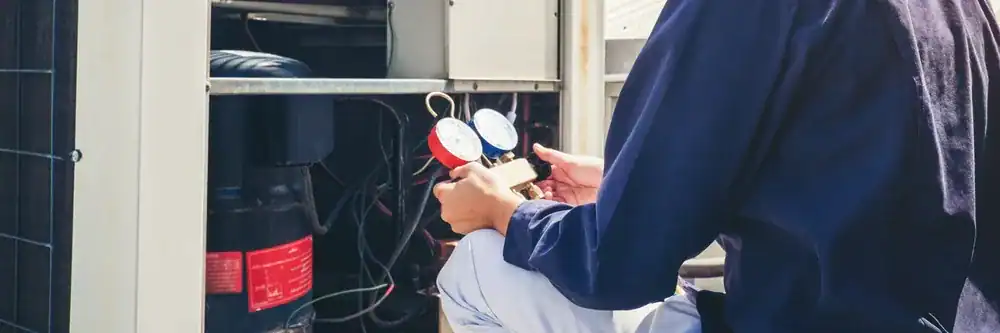
A proper diagnostic isn’t just a technician glancing at the unit and guessing. When one of our EPA-certified technicians comes out to your Nassau County home, we’re running through a systematic process — checking refrigerant pressure using superheat and subcooling readings, testing electrical components like the capacitor and contactor, inspecting the evaporator and condenser coils, measuring airflow, and evaluating the overall condition of the system.
This matters because the symptom — “it’s running but not cooling” — can have several different root causes, and the right fix depends entirely on which one it actually is. A technician who skips the diagnostic and just adds refrigerant without checking for a leak isn’t solving your problem. They’re delaying it, and usually making it worse.
We also give you a clear, upfront quote before any work begins. No surprises, no pressure. You’ll know exactly what the issue is, what it costs to fix it, and what the alternatives are. If the repair makes sense, we do it. If the system is old enough or damaged enough that replacement is the smarter financial move, we’ll tell you that honestly — and walk you through your options, including financing through Wells Fargo for American Standard systems and Synchrony for Mitsubishi.
During summer heat waves in Nassau County, most HVAC companies are booked out several days for non-emergency service. We offer same-day service and 24/7 emergency availability — nights, weekends, and holidays — because a failing AC at 10 PM on a Saturday in July is a real emergency, not something that can wait until Tuesday morning.
Should You Repair or Replace an AC That’s Not Cooling?
This is the question most homeowners are quietly dreading when they call. And the honest answer is: it depends on a few specific factors, not just the age of the system.
Age matters, but it’s not the only variable. A 12-year-old system with a failed capacitor and otherwise sound components may be worth repairing. A 10-year-old system with a major refrigerant leak, corroded coils, and a compressor showing signs of wear is a different conversation. The technician’s full assessment of the system’s overall condition — not just the presenting problem — is what drives a sound repair-versus-replace recommendation.
Efficiency is another factor that’s easy to undervalue. Older systems often run at significantly lower efficiency ratings than modern equipment. An American Standard system running at up to 22.0 SEER2 with AccuComfort™ variable-speed technology isn’t just more reliable — it’s built to handle the kind of sustained humidity loads that Nassau County summers throw at a system. Variable-speed compressors modulate their output based on actual demand, which means the system isn’t constantly cycling on and off at full blast trying to keep up. That matters a lot when it’s 90°F outside and the relative humidity is pushing 80%.
If you’re in a coastal Nassau County community and your outdoor unit has been dealing with salt air for years, replacement may make more practical sense than repairing a corroded system that will continue to degrade. In those cases, it’s also worth asking about equipment placement and protective coatings that can extend the life of a new unit in a high-corrosion environment.
The short version: don’t let the fear of a replacement conversation stop you from calling. Most of the time, the answer is a repair. And when it isn’t, knowing sooner rather than later puts you in a much better position to make a smart decision — financially and practically.
Still Not Cooling? Here’s the Next Step for Nassau County Homeowners
An AC that’s running but not cooling isn’t something to wait out. Whether it’s a clogged filter, a refrigerant leak, a failing capacitor, or something specific to your home’s age or coastal location, the problem has a real cause — and a real fix.
Start with the basics: check your filter, confirm your thermostat is set to “auto,” and make sure your outdoor unit isn’t blocked or visibly damaged. If those checks don’t resolve it, the system needs a professional diagnostic — not guesswork, not a refrigerant top-off without finding the leak.
COOL BROS CORP serves Nassau County homeowners with same-day and 24/7 emergency service, upfront pricing, and technicians who are EPA-certified and factory-trained. If your house is still hot and you’re ready to get an actual answer, give us a call.