It’s January. The temperature outside is dropping toward the teens, and you just realized your house isn’t warming up. You check the thermostat, feel the vents, and confirm what you already suspected — no heat. The panic sets in fast, especially if you’ve got kids in the house or an elderly parent down the hall.
Before you start calling every HVAC company in Nassau County, take a breath. Some furnace failures are genuine emergencies. Some are a dead battery away from being solved. Knowing which one you’re dealing with changes everything — including how fast you get your heat back.
Is Your Furnace Emergency a Safety Problem or a Comfort Problem?
This is the first question to ask — and most homeowners skip it entirely. Not every furnace failure carries the same urgency, and the difference matters before you do anything else.
If you smell gas anywhere in your home, stop reading and get everyone out immediately. Don’t flip light switches, don’t open the furnace panel, don’t try to find the source. Get outside, move away from the house, and call 911 and National Grid from your phone once you’re clear. That’s not an HVAC call — that’s an emergency services call.
If your carbon monoxide detector is going off, treat it the same way. Evacuate first, call 911, and don’t go back inside until emergency responders clear the building. A cracked heat exchanger can leak CO without any visible sign or smell — that’s exactly why these detectors exist.
If there’s no gas smell and no CO alarm, you’re likely dealing with a comfort problem, not a danger situation. That’s still urgent — especially in Nassau County winters — but it means you have a few minutes to triage before you pick up the phone.
What to Check Before You Call for Emergency Furnace Repair
Start with the thermostat. Dead thermostat batteries are one of the most common reasons a furnace appears to stop working. Swap them out, set the temperature five degrees above the current room temperature, and wait a minute to see if anything kicks on. If the display is blank or unresponsive, batteries are almost certainly the issue.
Next, check your circuit breaker. Furnaces are wired into your home’s electrical panel, and a tripped breaker will shut the whole system down. Look for any breaker in the middle position — not fully on, not fully off — and reset it by pushing it firmly to the off position first, then back to on. If it trips again immediately, leave it alone and call a technician. A breaker that keeps tripping is telling you something is wrong electrically, and that’s not a DIY fix.
While you’re at it, find the power switch on the furnace itself. It looks like a standard light switch, usually mounted on the wall near the unit or on the furnace cabinet. It gets bumped off more often than you’d think — sometimes during cleaning, sometimes when someone’s in the basement doing something unrelated. Make sure it’s in the on position.
Then check your air filter. A severely clogged filter restricts airflow to the point where the furnace triggers its own safety shutoff to prevent overheating. Pull the filter out and hold it up to a light. If you can’t see light through it, that’s your problem. A new filter runs $10 to $30 at any hardware store, and if that’s all it takes to restore heat, you’ve just saved yourself a service call fee. If you replace it and the furnace still won’t run, move on.
Finally, look for a small reset button on the furnace itself — usually a red or yellow button near the burner assembly. Some furnaces lock out after a fault and need a manual reset. Press it once and wait. If the furnace tries to start and fails again, don’t press it a third time. Repeated reset attempts on a furnace that won’t stay lit can flood the system with unburned gas, which creates a real hazard.
If you’ve worked through all of this and the furnace still isn’t running, you’ve done everything a homeowner should do. Now it’s time to call.
Emergency Heating Service in Nassau County: True 24/7 vs. Call-Back Service
Here’s something worth knowing before you start dialing: a lot of HVAC companies advertise 24/7 availability, but what they actually offer is 24/7 call answering. There’s a real difference. An answering service can take your information and tell you someone will call back in the morning. That’s not emergency service — that’s a scheduled appointment you didn’t know you were making.
True 24/7 emergency heating service means a licensed technician gets dispatched to your home tonight. Not tomorrow morning. Not when the office opens. Tonight. During a Nor’easter, when furnaces across Nassau County are all working overtime and failing at similar rates, that distinction is the difference between heat by midnight and heat by noon the next day.
This is especially relevant in Nassau County, where January temperatures regularly drop into the teens and wind chill can push the feels-like temperature well below zero. A home that starts at 68°F can drop to 50°F within a few hours without heat — faster if the house is older or poorly insulated. Many of the post-war ranches and Cape Cods in communities like Levittown, Seaford, and Massapequa weren’t built with modern insulation standards, and they lose heat quickly. For households with young children, elderly family members, or anyone with a health condition, that temperature drop isn’t just uncomfortable — it’s a genuine risk.
When you call for emergency furnace repair, ask directly: will a technician be dispatched tonight, or will someone call me back to schedule? The answer tells you everything about whether that company can actually help you right now.
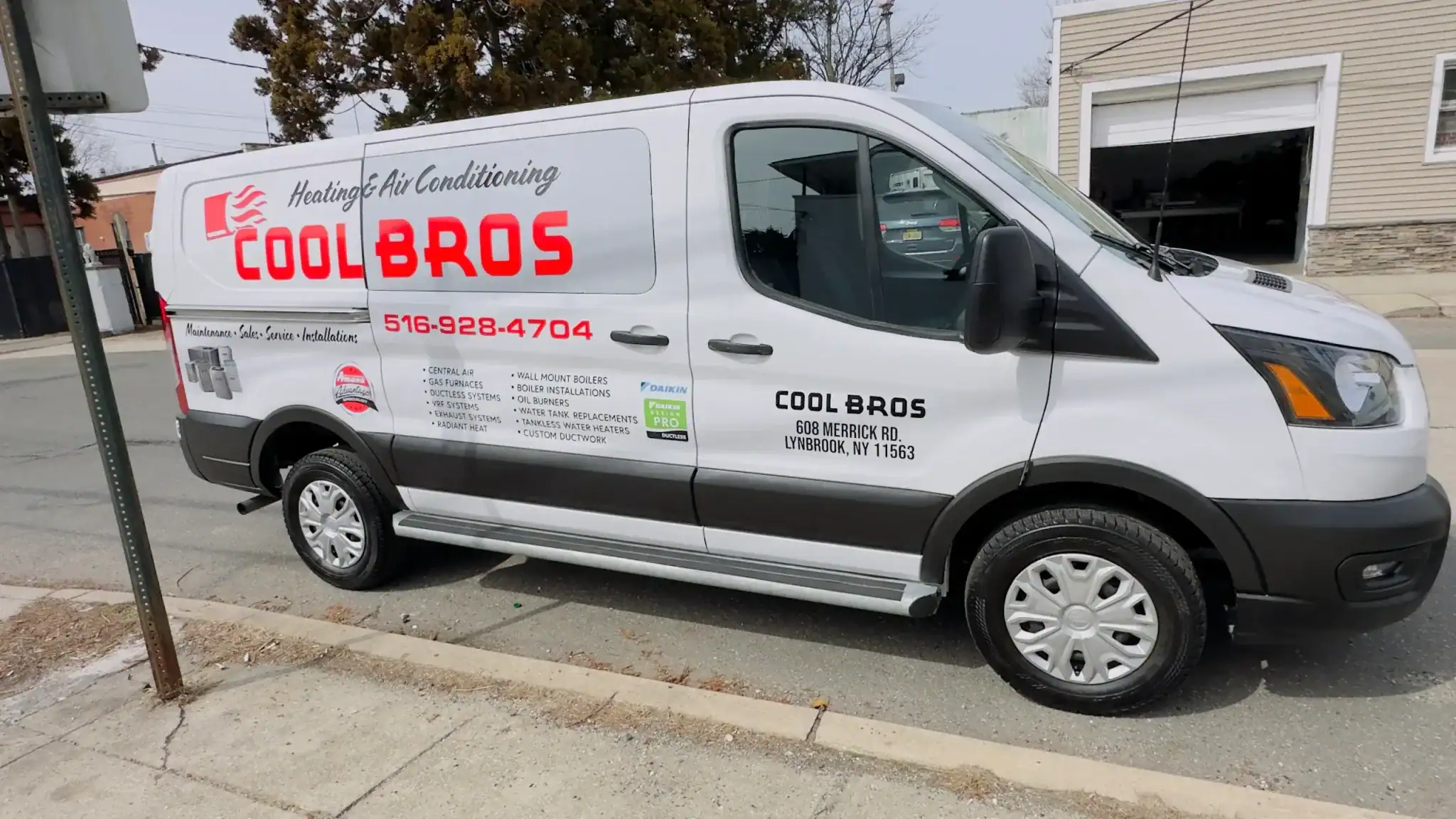
We dispatch technicians — not callbacks. One call and someone is on the way. We’re based in Lynbrook, which means our technicians are already in Nassau County when your call comes in, not driving in from Suffolk or Queens. We also keep our service vehicles stocked with the most common replacement parts — igniters, flame sensors, thermostats — so most repairs can be completed on the first visit. No waiting for parts to be ordered. No second trip.
What to Expect When an Emergency Furnace Repair Technician Arrives
Once a technician is on the way, you’ll want to know what to expect so the visit goes smoothly and efficiently. Clear a path to your furnace — remove anything stored in front of the unit, make sure the area is accessible, and have your thermostat settings visible. If you replaced the filter or reset the breaker during your triage, mention that when the tech arrives. It helps narrow the diagnosis faster.
A good technician will walk you through what they find before they do anything. You should receive a clear explanation of the problem and an upfront price before any work begins. If a company won’t give you a written estimate before starting, that’s a red flag — especially in an emergency situation where you’re already under pressure.
24-Hour Heater Repair: What a Same-Night Fix Actually Looks Like
Most middle-of-the-night furnace calls in Nassau County come down to a handful of common failures: a worn igniter that won’t spark, a flame sensor coated in residue that can’t detect a flame, a faulty control board, or a blower motor that’s given out. These aren’t rare or exotic problems — they’re the predictable wear patterns of systems that have been running for 10, 15, or 20 years. And because they’re predictable, a properly stocked service vehicle will have the parts on hand to fix them the same night.
Nassau County’s housing stock leans heavily toward older systems. The post-war building boom that created Levittown and dozens of surrounding communities also created an enormous inventory of homes that are now 60 to 70 years old — many of them still running on furnaces installed in the 1990s or early 2000s. A furnace from 1998 is 27 years old. The industry standard lifespan for a gas furnace is 15 to 20 years. If your system is in that range, it’s not a matter of if it’ll need emergency attention — it’s when.
That context matters when a technician gives you a repair-versus-replace assessment at 1 AM. A reputable technician will be honest with you: if the repair cost is approaching half the price of a new system and your furnace is already past its expected lifespan, replacement may be the smarter long-term move. But that’s a conversation, not a foregone conclusion — and you should never feel pressured into a major purchase during an emergency call. A technician who leads with replacement before fully diagnosing the problem is worth questioning.
For homeowners in coastal communities like Long Beach, Oceanside, or Freeport, there’s an additional factor worth knowing. Salt air accelerates corrosion on HVAC components — heat exchangers, burner assemblies, and outdoor equipment all degrade faster near the water. If your home is within a few miles of the South Shore, that wear pattern can shorten a system’s effective lifespan, which makes staying current on maintenance even more important.
How to Fix the Heater in Your House: FAQs Nassau County Homeowners Ask
**Can I fix the heater in my house myself?**
For the basic triage steps — thermostat batteries, circuit breaker, power switch, air filter, reset button — yes, those are safe for any homeowner to check. They don’t require tools, they don’t involve gas lines, and they won’t void your warranty. Beyond that, the answer is no. Anything involving the burner assembly, heat exchanger, gas valve, or internal electrical components should be handled by a licensed technician. Improper work on a gas appliance creates real safety hazards and can void manufacturer warranties.
**How much does emergency furnace repair cost in Nassau County, NY?**
Common repairs — igniter replacement, flame sensor cleaning, thermostat swap — typically fall in the $150 to $500 range. Diagnostic service calls generally run $89 to $150, and that fee is usually applied toward the repair cost. Major repairs or component replacements can run $500 to $1,500. Emergency after-hours calls typically carry a surcharge of $50 to $100 above standard rates. Those figures are worth knowing ahead of time so you’re not caught off guard when the technician hands you a quote.
**What if my furnace keeps shutting off after it starts?**
Short cycling — where the furnace kicks on, runs briefly, then shuts off and repeats — is usually a sign of an airflow problem, a faulty flame sensor, or an overheating issue triggered by a clogged filter. Start with the filter check. If that’s not it, the flame sensor is the next most likely culprit. It’s a common repair, and a technician with a stocked truck can usually handle it in one visit.
**How do I keep my house warm while waiting for the repair?**
Close off rooms you’re not using to concentrate heat in a smaller space. Use electric space heaters carefully — keep them away from curtains and furniture, never leave them unattended, and don’t run them in rooms where children are sleeping unsupervised. Layer up, and if the temperature inside drops below 55°F, consider moving vulnerable family members to a neighbor’s home or a hotel until the repair is done. Pipes can start freezing at sustained indoor temperatures below 55°F in Nassau County winters, which turns a heating problem into a plumbing problem fast.
**How often should I have my furnace serviced to avoid emergencies?**
Once a year, ideally in the fall before the heating season starts. A well-maintained furnace uses 5 to 15 percent less energy annually than a neglected one, and regular service catches the small problems — a worn igniter, a dirty flame sensor — before they become 2 AM emergencies. For Nassau County homeowners with older systems or homes near the water, annual service isn’t optional — it’s the difference between a furnace that lasts 20 years and one that fails at 15.
Emergency Furnace Repair in Nassau County: The Short Version
If your furnace stops working, start with the basics — thermostat batteries, the circuit breaker, the power switch, and the air filter. Those four checks take less than 15 minutes and resolve a surprising number of calls before a technician ever needs to show up. If you smell gas or your CO detector activates, skip the triage entirely and get out of the house immediately.
When the problem is real and you need someone tonight, make sure you’re calling a company that actually dispatches technicians after hours — not one that takes a message and calls back in the morning. Nassau County winters don’t leave much margin for that kind of delay.
We’ve been handling emergency furnace repair across Nassau County since 2016. Our NATE-certified technicians, stocked service vehicles, upfront pricing before any work begins, and genuine 24/7 dispatch policy set us apart. If your heat is out and you need it back tonight, give us a call.