Most Nassau County homeowners don’t think about their air conditioner until it stops working — usually on the hottest day of July, when every HVAC company in the county is already booked solid. By then, your options are limited and your house is miserable. The good news is that a single spring tune-up, scheduled before the season ramps up, prevents most of the breakdowns that cause that exact situation.
Here’s what a real air conditioning tune-up involves, what it actually checks, and why the timing matters more than most people realize — especially on Long Island.
What AC Unit Maintenance Actually Covers (And What It Doesn’t)
There’s a lot of confusion around what “AC maintenance” means. Some companies show up, glance at the outdoor unit, swap the filter, and call it done. That’s not a tune-up — that’s a visual inspection with a receipt attached.
A real air conditioning tune-up is a systematic check of every component that affects how your system performs under load, which in Nassau County means sustained heat and humidity from June through September.
The difference matters because most AC failures don’t happen out of nowhere. A capacitor weakens over months. Coils get coated in dust and lose their ability to transfer heat. The condensate drain gets clogged and can’t remove the moisture the system pulls out of your air. None of these problems announce themselves — they just quietly reduce your system’s efficiency until something finally gives out on an 88-degree afternoon.
What a Thorough AC Tune-Up Checklist Should Include
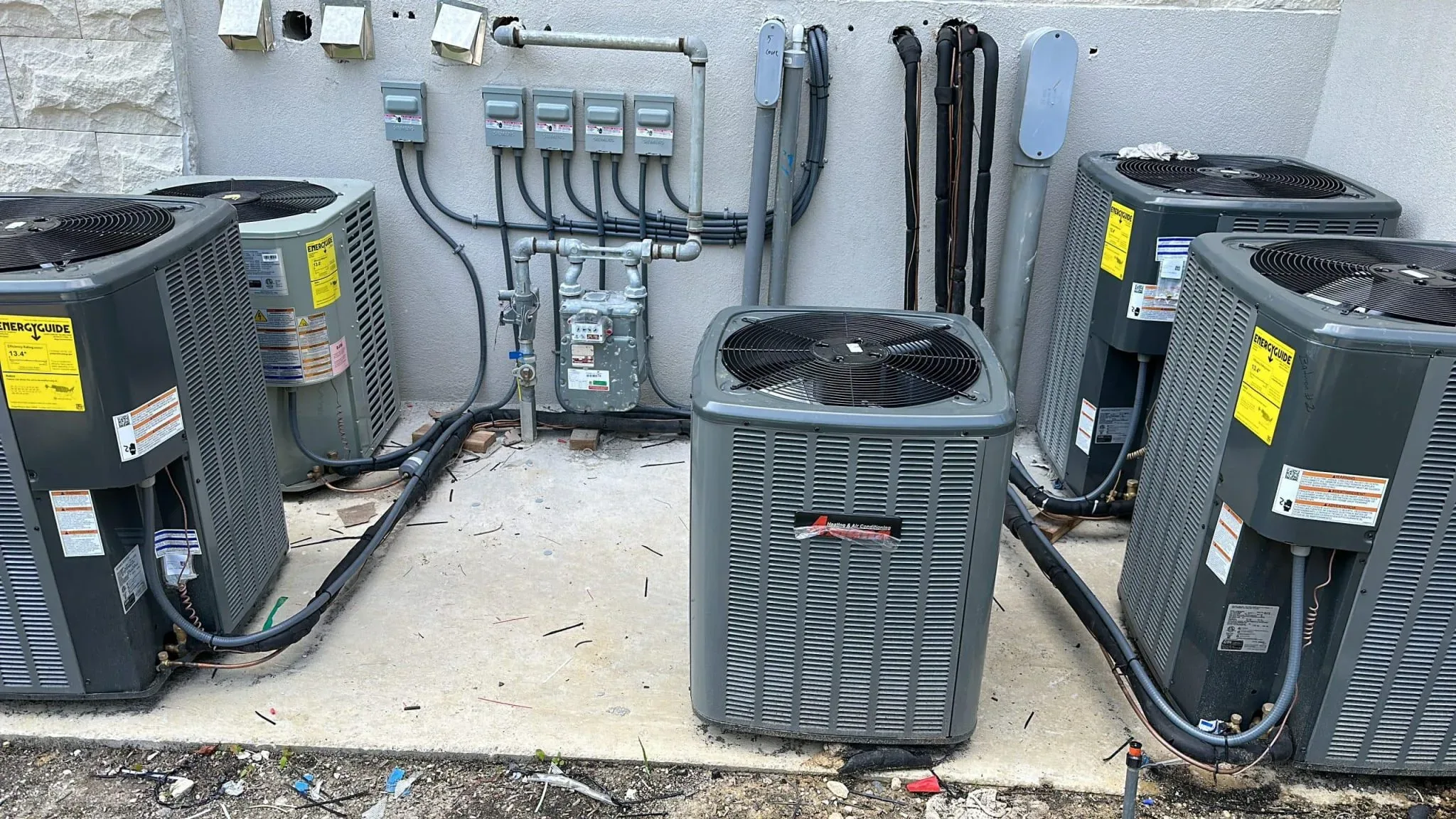
A complete tune-up covers far more than most homeowners expect. On the mechanical side, our technicians inspect and clean both the evaporator coil (the indoor coil that absorbs heat from your air) and the condenser coil (the outdoor coil that releases it). Both coils accumulate grime over time, and even a thin layer of buildup forces your system to work harder to move the same amount of heat.
That means longer run times, higher energy use, and more wear on the compressor — the most expensive component in the system.
Refrigerant levels need to be checked with precision. Not a glance at an analog gauge, but an actual measurement using calibrated digital gauges that confirm the system is charged to manufacturer spec. Low refrigerant doesn’t just reduce cooling — it stresses the compressor and can cause it to overheat. If refrigerant is low, that also means there’s a leak somewhere, which needs to be found and addressed, not just topped off.
Electrical connections should be inspected and tightened. Loose connections cause resistance, resistance causes heat, and heat causes failures — sometimes sudden ones. Capacitors and contactors, the components that start and run your motors, should be tested for proper function. These are among the most common failure points in any AC system, and they’re cheap to replace during a tune-up. They’re significantly less cheap to deal with when they fail mid-summer and take the blower motor or compressor with them.
The condensate drain line deserves its own mention, particularly in Nassau County. Long Island’s summer humidity means your AC is pulling a substantial amount of moisture out of the air on top of cooling it. That moisture has to go somewhere — through the drain line and out of your home. When the drain line is clogged with algae or debris, that water backs up. At best, you get a wet spot near the air handler. At worst, you get water damage and mold growth.
Clearing the drain line is a routine part of any proper tune-up, and it’s one of the checks that matters most in a coastal, high-humidity market like ours.
Fan motors and bearings get lubricated. Airflow and static pressure get measured. The thermostat gets tested for accuracy. At the end of a good tune-up, we walk you through exactly what we found — not hand you a receipt and leave.
When Is the Best Time to Schedule an AC Tune-Up in Nassau County?
The short answer: March or April. Before the heat arrives, before the schedule fills up, and before you’re competing with every other homeowner in Hempstead, Massapequa, and across Nassau County who waited until their system started struggling.
Nassau County’s cooling season starts in earnest around late May and runs hard through August. July and August are the months when HVAC companies get overwhelmed with emergency calls — systems that weren’t maintained failing under the load of consecutive 85-degree days with high humidity. If you try to schedule a tune-up in June, you may wait weeks. If something breaks in July, you may wait longer.
Booking in early spring also gives you time to act on whatever the tune-up uncovers. If a capacitor needs replacing, that’s a quick fix. If we find that your refrigerant is low and trace it to a slow leak in the coil, you want to know that in April — not the first week of July. And if the system is old enough that the honest recommendation is to start thinking about replacement, you want that conversation with enough runway to make a thoughtful decision rather than a panicked one.
We recommend Nassau County homeowners schedule AC service at least once before summer and once before winter. The pre-summer visit is the more critical of the two — it’s the one that determines whether your system is ready for the months ahead. Homes in Levittown, Long Beach, Oceanside, and other parts of Nassau County that sit closer to the water deal with particularly high latent humidity loads in summer, and those conditions accelerate the buildup on coils and in drain lines. Getting ahead of that is the whole point.
How to Know When to Replace Your Air Conditioner Instead of Tune It Up
A tune-up is the right call for a system that’s fundamentally sound but needs to be cleaned, calibrated, and confirmed ready for the season. It’s not the right call for a system that’s failing. Knowing the difference saves you from throwing money at a unit that’s already on its way out — and from replacing a system prematurely when a good tune-up would have bought you several more years.
The clearest signal is age. Most AC systems have a functional lifespan of 15 to 20 years with proper maintenance. If your system is pushing 15 years old, has needed multiple repairs in recent seasons, and still isn’t cooling your home evenly, the math on continued repair starts to shift. A tune-up on a system in that condition might buy you one more summer — or it might surface a repair estimate that makes replacement the obvious answer.
Signs Your AC System May Be Past the Point of Maintenance
There are a few patterns that show up consistently in systems that are approaching end of life. Uneven cooling is one of the most telling — if some rooms in your home are comfortable while others stay warm no matter how long the system runs, that’s worth investigating. It could be a ductwork issue, a refrigerant problem, or a sign that the system no longer has the capacity to handle the load.
Frequent cycling — the system turning on and off more often than normal — is another flag. So is a noticeable increase in your PSEG Long Island electric bill without a clear explanation. An AC system that’s losing efficiency doesn’t announce it with a warning light. It just runs longer and costs more to do less.
If your system is over 15 years old and you’re looking at a repair estimate for a major component — compressor, coil, or refrigerant leak that requires significant work — it’s worth getting a replacement quote at the same time. The math often favors replacement when you factor in the remaining lifespan of the old unit, the cost of the repair, and the efficiency difference between a system from 2008 and a modern American Standard system rated up to 22.0 SEER2. That efficiency gap translates to real savings on every monthly bill going forward.
Most manufacturer warranties require documented annual maintenance to remain valid. If your system is still under a parts warranty and you haven’t been keeping up with annual service, a warranty claim could be denied on those grounds. Getting a tune-up on record isn’t just about performance; it protects the coverage you’re already paying for through the cost of the equipment.
We offer free estimates on new systems, and if a tune-up reveals that replacement is the better path, we’ll tell you that directly. No pressure, no upsell — just an honest look at what makes sense for your home and your budget.
Already Dealing With a Breakdown? We Handle Emergency AC Repair Too
Sometimes the tune-up conversation happens too late. The system that should have been serviced in April stops cooling in the middle of a July heat wave, and now you’re dealing with an emergency. It happens — and when it does, you need someone who can actually show up, not put you on a three-day waiting list.
We offer true 24/7 emergency AC repair, including nights, weekends, and holidays. Same-day service is available for Nassau County homeowners who need it. Whether you’re in Valley Stream, Garden City, Mineola, or anywhere else in the county, our NATE-certified technicians can diagnose the problem and get your system running again as quickly as possible.
The reason we emphasize pre-season tune-ups isn’t to sell you a service you don’t need — it’s because we’ve seen what happens when they get skipped. The calls we get in July and August are almost always for systems that showed early warning signs months earlier. A dirty condenser coil that was working at 70% capacity in May becomes a failed compressor in August. A weak capacitor that would have cost a fraction of the price to replace during a tune-up takes a blower motor with it when it finally goes.
The emergency repair is almost always more expensive than the maintenance that would have prevented it. If you’re already in that situation, call us and we’ll take care of it. But if you’re reading this in the spring and your system hasn’t been serviced yet, that’s the better window — for your schedule, your budget, and your peace of mind when the real heat arrives.
Nassau County summers don’t give you a grace period. Your AC either goes into the season ready, or it doesn’t.
Is Your Nassau County Home Ready for Summer? Here’s What to Do Next
A proper air conditioning tune-up isn’t a luxury — it’s the most cost-effective thing you can do to protect a system that costs thousands of dollars to replace and keeps your home livable through a Nassau County summer. The window to get it done right is early spring, before the heat arrives and the schedule fills up.
If your system is under 15 years old and hasn’t had any major issues, a tune-up is almost certainly the right call. If it’s older, showing signs of struggle, or hasn’t been serviced in years, the tune-up is still where you start — because it gives you a clear, honest picture of what you’re actually working with.
Cool Bros Corp is based in Lynbrook and serves homeowners across Nassau County — from Elmont to Massapequa, from Long Beach to New Hyde Park. We’ve built a 5.0-star reputation across 142+ verified reviews by being straight with people and doing the work right. If you’re ready to get your system ready for summer, reach out to Cool Bros Corp and we’ll take it from there.