You’re not an HVAC expert — and you shouldn’t have to be. But when your AC stops working in the middle of a Nassau County July, or you’re staring down a system that’s clearly on its last legs, you need to make a fast decision about who to call. The problem is, most people have no idea what a legitimate AC air conditioning company actually does. What’s a fair process? What should they check? What are the warning signs that something’s off? This page answers all of that — plainly, without the industry spin — so you can hire with confidence.
What Does an AC Air Conditioning Company Actually Do?
At its core, a professional AC company handles the installation, repair, maintenance, and replacement of cooling systems — but the quality of how they do all of that varies enormously. The difference between a contractor who shows up, guesses at a solution, and disappears versus one who diagnoses carefully, explains clearly, and stands behind the work is significant.
In Nassau County’s climate, where summer humidity and heat demand reliable cooling from July through September, that difference can determine whether your system holds up for 15 years or fails in 7.
A good AC company starts with a real assessment — not a glance at your unit and a number pulled from thin air. They ask about your home’s layout, check the existing ductwork, evaluate your insulation, and perform what’s called a Manual J load calculation to determine exactly what size system your space actually needs. Skipping that step is one of the most common mistakes in the industry, and it leads to oversized systems that short-cycle, fail to dehumidify properly, and wear out faster than they should.
What Happens During a Professional AC Service Visit?
The first thing a qualified technician should do when they arrive is listen. That means asking what you’ve noticed — unusual sounds, warm spots, higher energy bills, anything that’s changed. A good tech treats your observations as data, not background noise.
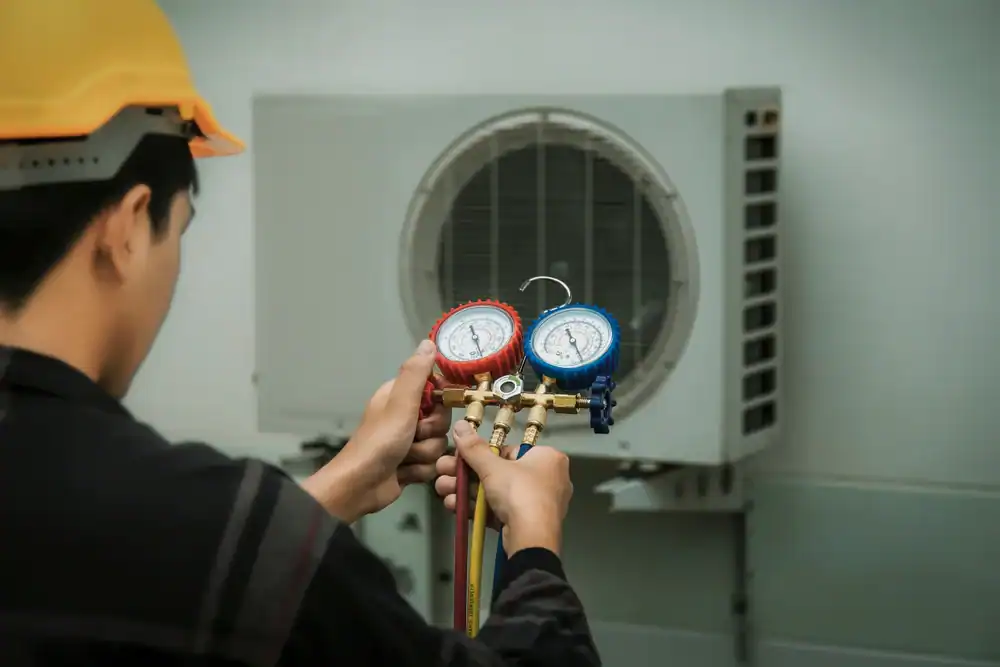
From there, the diagnostic process begins. For a repair call, that means checking refrigerant levels, inspecting electrical connections, testing the thermostat, examining the condenser and evaporator coils, and evaluating airflow. For a new installation estimate, it means measuring your space, assessing your ductwork, and running that load calculation we mentioned. Either way, the technician should be explaining what they’re finding as they go — not just handing you a number at the end and waiting for a yes.
This is where a lot of homeowners get nervous, and understandably so. The BBB processes nearly 5,000 complaints about HVAC companies every single year, with surprise charges and work not done as contracted topping the list. Before any work begins, you should receive a written estimate that clearly outlines what’s being done and what it costs. Not a verbal ballpark. A written estimate. If a contractor is reluctant to put it in writing, that’s a signal worth paying attention to.
After the work is done — whether it’s a repair or a full installation — a professional company doesn’t vanish. They walk you through what was done, explain how to operate the system properly, and make sure you know how to reach them if something comes up. That post-job follow-through matters more than most homeowners realize until they need it.
How to Tell If an AC Company Is Actually Qualified
Nassau County has its own licensing layer that goes beyond what New York State requires. Any contractor performing home improvement work over $200 in Nassau County needs a Home Improvement Contractor license issued by the Nassau County Office of Consumer Affairs — and getting that license requires passing a written exam, submitting fingerprints, and clearing a criminal background check. You can verify a contractor’s license number before anyone sets foot in your house.
Beyond the local license, look for EPA Section 608 Certification — a federal requirement for any technician who handles refrigerants. This one isn’t optional and it never expires, so there’s no excuse for a legitimate HVAC technician not to hold it. NATE certification (North American Technician Excellence) is the voluntary credential that separates technicians who’ve proven their technical mastery from those who simply have experience. It’s the HVAC industry’s most recognized competency standard, and not every company employs NATE-certified techs.
Insurance is the other piece most homeowners forget to ask about. A contractor working in your home should carry general liability coverage — not just a claim on their website, but a verifiable policy with a named carrier and a dollar amount. Asking for proof of insurance before work begins isn’t rude; it’s responsible.
For Nassau County homeowners on the South Shore — in Long Beach, Atlantic Beach, Freeport, or anywhere within about a mile of the coastline — salt air accelerates corrosion on outdoor condenser units significantly. An informed local contractor will account for that, recommending equipment with appropriate coatings and factoring the coastal environment into their maintenance recommendations. A contractor who doesn’t mention it probably hasn’t worked much in your neighborhood.
Commercial Heating and Cooling Companies in Nassau County
Commercial HVAC is a different animal from residential work, and not every AC air conditioning company is equipped to handle both. The equipment is larger, the load calculations are more complex, zoning requirements differ, and the stakes of a system failure are higher — because it’s not just comfort on the line, it’s your business operations.
If you’re a Nassau County business owner, it’s worth understanding what commercial air conditioning companies actually offer before you hire someone who primarily works on homes. The process, the equipment, and the service expectations are all distinct.
Commercial Heating and Cooling: What Business Owners Should Know
Commercial heating and cooling systems are designed to manage much larger and more variable loads than residential systems. A retail space in Hempstead, a medical office in Garden City, or a multi-tenant building in Rockville Centre all have different occupancy patterns, ventilation requirements, and temperature control needs — and a properly designed commercial HVAC system accounts for all of it.
Where a residential system typically serves a single thermostat zone, commercial systems often require multi-zone configurations so different areas of a building can be controlled independently. A reception area, a server room, and a back office don’t need the same temperature at the same time, and a good commercial system lets you manage that without wasting energy on spaces that don’t need it.
Maintenance schedules are also more demanding on the commercial side. A residential system might need a tune-up twice a year. A commercial system — depending on its size, usage hours, and the nature of the business — may require more frequent inspections to maintain efficiency and avoid costly mid-season failures. For a business, a breakdown in August isn’t just uncomfortable; it can mean closed doors and lost revenue.
What to look for in a commercial AC company is similar to the residential checklist — licensing, insurance, certification — but you should also ask specifically about their experience with commercial-scale equipment, their familiarity with Nassau County’s commercial permitting process, and whether they offer service agreements that keep your system on a regular maintenance schedule rather than waiting for something to break.
How We Approach Both Residential and Commercial HVAC in Nassau County
At COOL BROS CORP, we work with both homeowners and business owners across Nassau County — and we approach each job the same way regardless of scale. We show up when we say we will. We explain what we find before we start any work. And we don’t disappear after the job is done.
For residential clients, that means free estimates on new systems, Manual J load calculations on every install, and access to American Standard systems that reach up to 22.0 SEER2 efficiency with AccuComfort™ variable-speed technology — along with a 10-Year Limited Warranty that’s only available through authorized dealers like us. For clients who prefer ductless, we install and service Mitsubishi Electric mini-split systems, with financing available through Synchrony. Wells Fargo financing is available for American Standard products as well, so a major system investment doesn’t have to mean a major upfront expense.
For commercial clients, we bring the same licensed, NATE-certified technicians and the same commitment to doing the work right the first time. Nassau County’s commercial properties have their own quirks — older building stock, mixed-use configurations, tight mechanical spaces — and we’ve worked across enough of them to know what to expect before we open a panel.
We’re based in Lynbrook, which puts us in a good position to reach most of Nassau County quickly. We carry a $1,000,000 liability insurance policy, hold Nassau County Home Improvement Contractor license H36422800, and our technicians are EPA certified and background-checked. We’re BBB Accredited with an A+ rating, and we have 142+ verified 5-star reviews from real Nassau County clients — not because we ask people to leave reviews, but because the work holds up.
If you’ve had a bad experience with an HVAC contractor before — the kind who quoted one thing and charged another, or who handed you a new system recommendation without ever measuring your space — we understand why you’re skeptical. That skepticism is healthy. We’d rather earn your trust by walking you through exactly what we’ll do than ask you to take our word for it.
Finding the Right AC Company in Nassau County Starts With Knowing What to Ask
Hiring an AC air conditioning company doesn’t have to feel like a gamble. When you know what the right process looks like — proper diagnostics, written estimates, verified credentials, clear communication before and after the job — it’s a lot easier to tell the difference between a contractor worth trusting and one who’s going to cost you more in the long run.
Nassau County’s summers are demanding, its housing stock is varied, and its coastal communities add a layer of complexity that not every HVAC company is prepared for. The right company knows all of that before they walk through your door.
If you’re ready to talk through what your home or business actually needs, COOL BROS CORP is here. No pressure, no guesswork — just a straightforward conversation about what’s going on and what makes sense for your situation.