It’s late. Your AC stopped blowing cold air, or your heat just quit on a night when the temperature is dropping fast. You’re not sure if this is a call-someone-right-now situation or a wait-until-morning situation — and either way, you have no idea who to trust at this hour.
That uncertainty is exactly what this post is for. We’ll walk you through what to check first, how to decide if it’s a genuine emergency, and what separates a reliable HVAC company from one that will overcharge you and underdeliver. By the end, you’ll know what to do — and what to avoid.
What to Do the Moment Your HVAC Stops Working
Before you call anyone, take two minutes to check the basics. Around 15 to 20 percent of emergency service calls turn out to be something you could have resolved without a technician — a tripped circuit breaker, a thermostat set to the wrong mode, or an air filter so clogged it shut the system down on its own.
Check your thermostat first. Make sure it’s set to the right mode — heat or cool — and that the temperature is actually set higher or lower than the current room temperature. Then check your electrical panel for a tripped breaker. Finally, if you can safely access your air filter, look at it. A completely blocked filter can cause a system to overheat and shut itself off as a safety measure.
If none of that resolves it, you’re past the DIY phase. Time to decide whether this needs a call tonight or can wait until morning.
How to Tell If Your HVAC Problem Is a True Emergency
Not every HVAC failure is a middle-of-the-night emergency — but some absolutely are, and misjudging the difference can be costly in more ways than one.
The clearest signal to call immediately, regardless of the hour, is anything involving a gas smell, a burning odor, or visible smoke near your unit. If you smell gas, don’t touch the thermostat, don’t flip any switches, and don’t try to diagnose it yourself. Get everyone out of the house, leave the door open as you go, and call your gas provider and 911 from outside. That’s not an HVAC call — that’s a safety emergency. Once it’s cleared, then you bring in a technician.
Beyond the obvious safety scenarios, the question becomes: how dangerous is the temperature inside your home right now, and who’s in it? Nassau County summers are no joke. July heat index values regularly climb into the upper 90s, and during a heat advisory — which the National Weather Service issues when conditions feel like 95°F or higher for two or more consecutive days — indoor temperatures in a home without functioning AC can reach dangerous levels within hours. If you have young children, elderly family members, or anyone with a medical condition in the house, that changes the calculus. Don’t wait.
The same logic applies in winter. Nassau County winters routinely drop to the mid-20s. A failed furnace or boiler isn’t just uncomfortable — it creates real risk of burst pipes, which can cause thousands of dollars in water damage on top of the repair bill. If it’s below freezing outside and your heat is out, that’s a call you make tonight.
If it’s a warm spring evening and your AC is running slightly warm but still functioning, that’s probably a morning call. If it’s 90 degrees out and the house is already at 85°F with no relief in sight, that’s tonight. Use your judgment, but don’t let the late hour talk you out of calling when the situation genuinely warrants it.
How to Quickly Vet an Emergency HVAC Company Before You Book
Here’s something no one tells you when your HVAC goes down at 10 PM: the hardest part isn’t finding a company that says they’re available — it’s finding one that actually is, and that you can actually trust.
Almost every HVAC company in Nassau County lists “24/7 emergency service” on their website. What that often means in practice is a voicemail box, an answering service with no dispatch authority, or a callback the next morning. Before you commit to anyone, call the number and see who answers. If it’s a real person who can tell you when a technician will arrive, that’s a meaningful sign. If it’s a recording, keep looking.
Once you’ve confirmed they can actually come, ask a few quick questions. Are your technicians EPA-certified? This isn’t optional — under the Clean Air Act, any technician who handles refrigerants is federally required to hold EPA Section 608 certification. No certification means they’re operating illegally, and it’s a hard disqualifier. Are they NATE-certified? NATE — the North American Technician Excellence certification — is the most widely recognized exam-based credential in the HVAC industry, and not every local company’s technicians hold it. It’s worth asking.
Also ask about pricing before you agree to anything. Specifically: is there an after-hours or emergency service fee, and will you be told the cost before any work begins? We give you a number upfront. If a company won’t tell you what the service call costs until after the technician has already been to your home, that’s a red flag worth taking seriously.
In Nassau County, HVAC contractors are also required to hold a Home Improvement Contractor license issued by the Nassau County Office of Consumer Affairs — not a statewide license, because New York doesn’t issue one. If you want to verify a contractor’s credentials before they arrive, that’s the office to call. It takes about two minutes and gives you real peace of mind.
One more thing worth checking: Google reviews. Not just the star rating, but the number of reviews and what people are actually saying. A 4.8 with 12 reviews tells you very little. A 5.0 with over a hundred verified reviews from Nassau County homeowners tells you something real.
Why Nassau County Homes Are Especially Vulnerable to HVAC Emergencies
Nassau County has a few specific factors that make HVAC failures hit harder here than in most markets — and understanding them helps explain why prevention and fast response both matter more than people realize.
The housing stock is a big part of it. A large share of Nassau County homes were built in the post-WWII era — Levittown ranches, Cape Cods, split-levels — and many are still running on cast-iron boilers from the 1970s and 1980s. These systems are well past their design life, and when they fail, they tend to fail completely rather than gradually. There’s no “it’s running a little warm” warning. One day it works, the next day it doesn’t.
The climate compounds the problem. Nassau County sits in ASHRAE Climate Zone 4A — a mixed-humid classification that demands systems capable of handling both brutal summer humidity and genuine winter cold. That’s a lot of stress on equipment that may already be aging.
The Coastal Factor: Why South Shore Homes Face Faster Equipment Wear
If you live in Long Beach, Atlantic Beach, Freeport, Baldwin Harbor, or anywhere else along Nassau County’s south shore, your outdoor HVAC equipment is dealing with something that inland homeowners don’t have to think about: salt air.
Coastal environments accelerate corrosion on condenser coils, copper refrigerant lines, and electrical components in ways that can shorten equipment lifespan by years. A system that might last 15 to 18 years in Levittown or New Hyde Park might need significant repairs or replacement several years earlier in a waterfront community. This is a straightforward function of chemistry and proximity to the ocean.
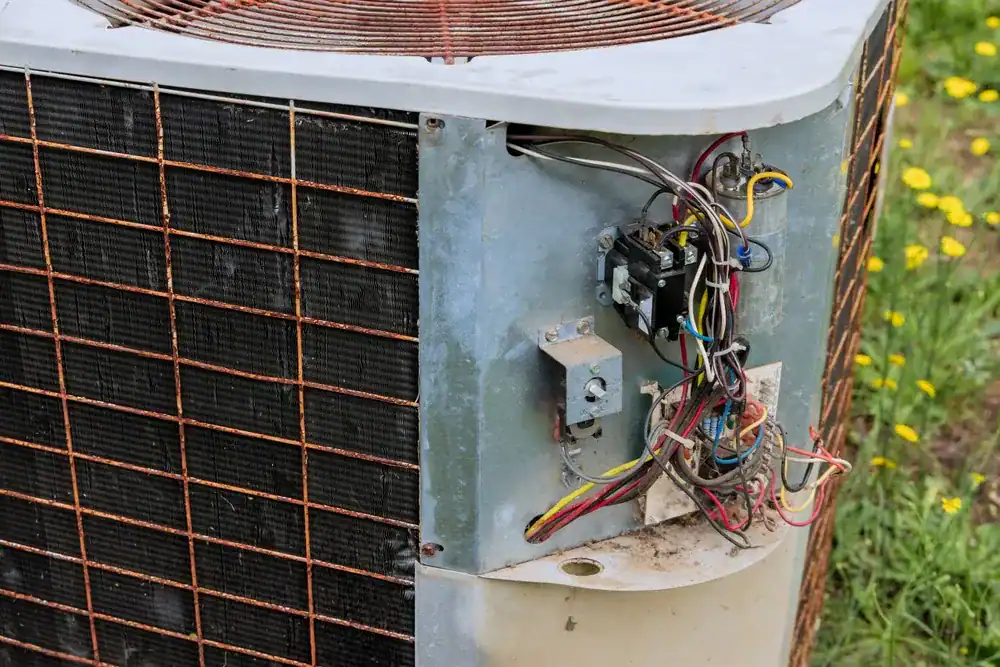
What it means practically is that if you’re in a south shore community and your outdoor unit is more than 10 years old, it deserves more frequent inspection than the standard annual tune-up. Salt deposits on condenser fins, rust on the cabinet, and corroded electrical contacts are all signs that your system is working harder than it should be. Catching these issues during a maintenance visit is dramatically cheaper than catching them during a failure on a 95-degree day in July.
It also means that when you’re replacing equipment, the choice of unit matters more than it might for someone living further inland. Systems with coated coils and corrosion-resistant components are worth the consideration — not as an upsell, but as a practical decision for where you actually live.
The broader point is that HVAC in Nassau County isn’t a generic suburban problem. The specific conditions here — the coastal exposure, the aging housing stock, the climate extremes — create a repair and maintenance landscape that’s worth understanding, not just reacting to.
Frequently Asked Questions About Urgent HVAC Repair in Nassau County
**Do HVAC companies charge more for after-hours emergency calls?**
Many do, and there’s nothing wrong with that — showing up at 11 PM on a Saturday requires staffing and logistics that a standard weekday appointment doesn’t. What matters is that the fee is disclosed before a technician is dispatched, not after they’ve already arrived. Ask what the service call or diagnostic fee is before you confirm the appointment. We tell you the cost upfront, and any company worth hiring will do the same.
**Is it safe to keep running my system if it’s making a strange noise?**
It depends on the noise. A faint hum or the occasional click is usually normal. Grinding, banging, or a persistent high-pitched squealing is not — those sounds typically indicate a mechanical component that’s failing, and running the system can accelerate the damage or cause a complete failure. If you’re hearing something that doesn’t sound right, turn the system off at the thermostat and call for a diagnostic. The repair will almost certainly be less expensive if you catch it before the component fails entirely.
**What is an HVAC general contractor, and do I need one for an emergency repair?**
An HVAC general contractor is a licensed contractor who can manage the full scope of HVAC work — not just the hands-on repair, but also system replacement, permit pulling, inspections, and equipment sourcing. For most emergency repairs, a licensed HVAC technician is sufficient. But if the emergency reveals that your system needs to be replaced, or that ductwork modifications are required, you’ll want a company that can handle the complete project — not just the immediate fix. In Nassau County, the relevant license is a Home Improvement Contractor license from the Nassau County Office of Consumer Affairs. We can handle whatever the situation turns into, whether it’s a capacitor swap or a full system replacement.
**How can I reduce the chances of an HVAC emergency happening in the first place?**
Annual maintenance is the most straightforward answer. Homeowners who schedule a tune-up once a year are statistically about 50 percent less likely to experience an emergency breakdown — and their systems tend to run 15 to 20 percent more efficiently in the process. In Nassau County’s climate, where summers are humid and winters are genuinely cold, a system that hasn’t been serviced in two or three years is running on borrowed time. A pre-season check in late spring and another before winter is a reasonable standard for most homes in the area.
**Does COOL BROS CORP actually answer the phone at 2 AM?**
Yes. We offer real 24/7 emergency service — not a voicemail, not an answering service, not a callback the next morning. Nights, weekends, and holidays. One call and a licensed technician is on the way. We’re based in Lynbrook and serve Nassau County, so you’re reaching someone who can actually help when you call.
When Your HVAC Fails in Nassau County, Here’s the Bottom Line
Most HVAC emergencies feel more overwhelming than they actually are — especially at midnight, especially in the middle of a heat wave or a cold snap. The difference between a bad outcome and a manageable one usually comes down to two things: knowing what to do in the first few minutes, and calling a company you can actually trust.
Check the basics first. Assess the real risk level — who’s in the house, what the temperature is, whether there are any safety concerns. Then call someone who answers the phone, tells you the cost upfront, and sends a certified technician who can actually fix it on the first visit.
If you’re in Nassau County and you need help tonight — or you want to get ahead of the next emergency before it happens — COOL BROS CORP is here. NATE-certified, EPA-certified, BBB A+ rated, and locally based in Lynbrook. Give us a call.