It was fine yesterday. Now it’s pushing 90 degrees outside, your house is getting warmer by the hour, and you have no idea if you’re looking at a tripped breaker or a dead compressor. That gap between “something’s wrong” and “what does this actually cost me” is where a lot of Nassau County homeowners get stuck — and sometimes get taken advantage of.
Before you call anyone, there are six things worth checking. Some of them you can handle yourself in under five minutes. Others will tell you exactly what kind of problem you’re dealing with so you’re not walking into a service call blind.
Why Your Air Conditioner Stops Working — And What’s Actually Going On
Most AC failures aren’t mysterious. The system is made up of a handful of key components — a compressor, a blower fan, an evaporator coil, a condenser unit outside, and a refrigerant circuit connecting them — and when any one of those stops doing its job, the whole thing falls apart.
The tricky part is that the symptoms often look the same on the surface: the house isn’t cooling, or nothing’s running at all. What matters is figuring out where in the chain the problem started. That’s what these six checks are designed to do — walk you through the most common failure points, in order of how likely they are, so you’re not guessing.
The 6 Most Common Reasons an AC Stops Working
Start with the thermostat. It sounds obvious, but thermostat settings are responsible for more “broken AC” calls than most people expect. Make sure it’s set to Cool, that the target temperature is actually lower than the current room temperature, and — this one matters — that the fan is set to Auto, not On. When the fan is set to On, it runs continuously even when the system isn’t actively cooling, which means it can blow warm, unconditioned air through your vents and make you think something’s broken when it isn’t.
Next, check your circuit breaker. This is the single most common cause of a sudden AC failure. A tripped breaker cuts power to the outdoor condenser unit while the indoor air handler keeps running — so you’ll feel air moving, but it won’t be cold. Go to your electrical panel, find the breaker labeled for your AC or air handler, and reset it if it’s tripped. If it trips again immediately, stop there and call a technician. A breaker that won’t hold is telling you something.
Third: your air filter. A clogged filter doesn’t just reduce airflow — it can trigger a cascade of problems. When airflow is restricted, the evaporator coil gets too cold and freezes over. A frozen coil blocks airflow entirely and can eventually damage the compressor, which is the most expensive component in the system.
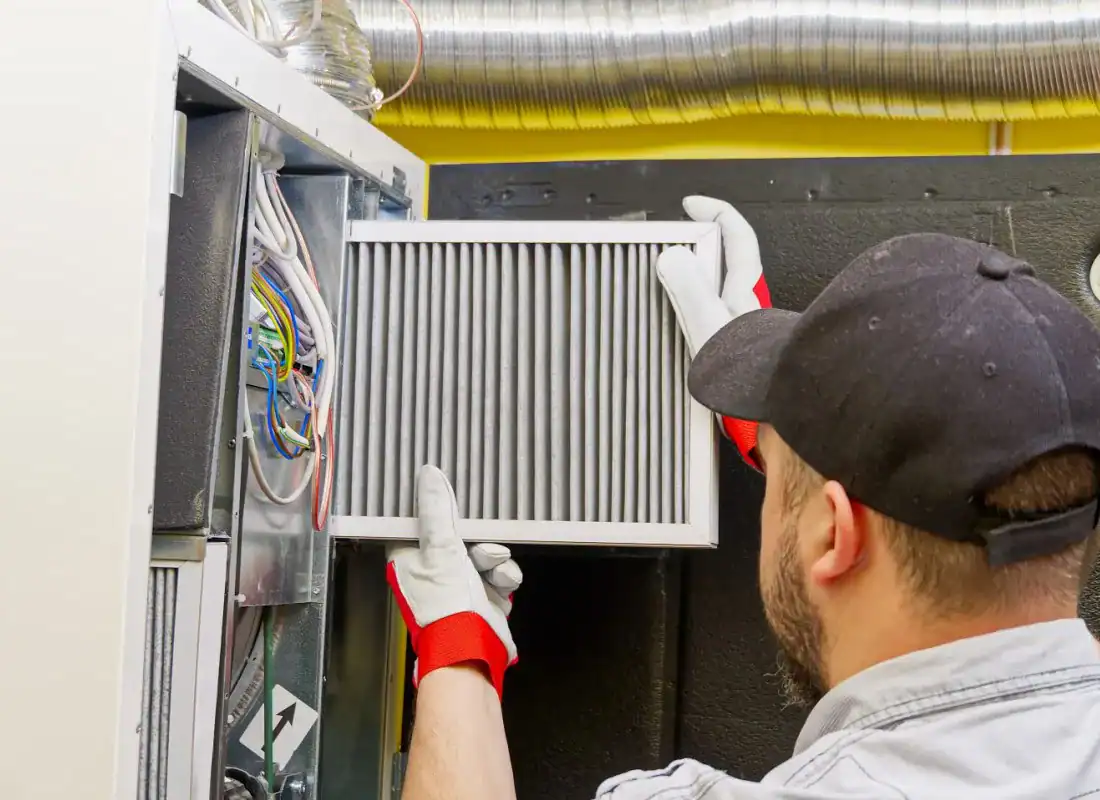
Pull the filter out and hold it up to a light source. If you can’t see light through it, replace it. Filters in Nassau County homes — especially in older houses with ductwork that wasn’t originally designed for central air — tend to clog faster than manufacturers’ suggested intervals.
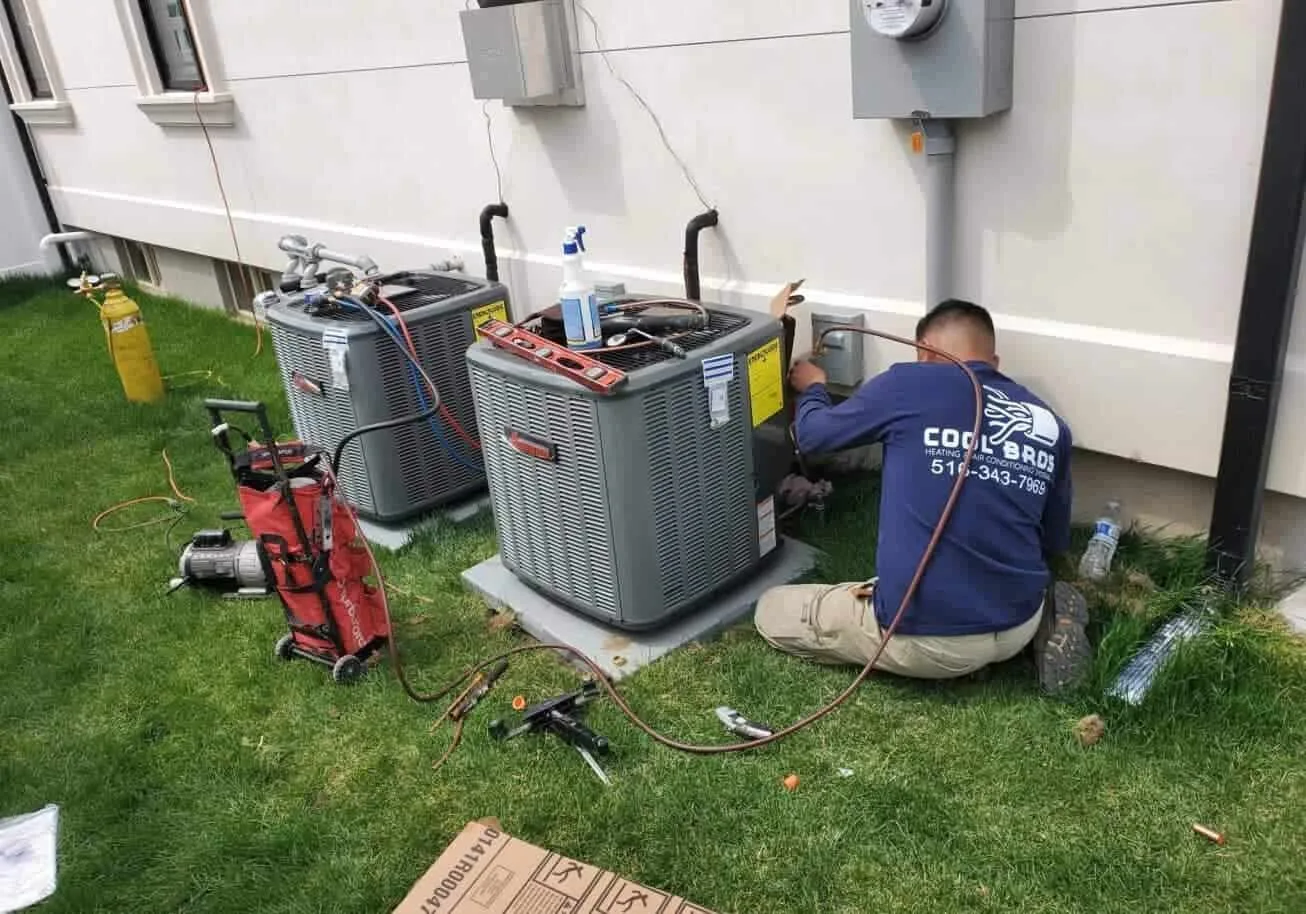
Fourth, go outside and look at your condenser unit. Is it running? Is the fan spinning? Is there debris — leaves, grass clippings, overgrown shrubs — packed against the sides or top? The condenser needs airflow to release heat, and if it’s blocked or the fan isn’t turning, the system can’t complete its cooling cycle. If the unit is completely silent and nothing is running, it may be a capacitor issue or a separate disconnect switch near the unit that’s been switched off.
Fifth, check for a frozen evaporator coil. If your indoor air handler has ice forming on the refrigerant lines or on the unit itself, the system needs to be shut off and allowed to thaw before it can work again. Running it while frozen causes damage. Turn the system off, switch the fan to On to help melt the ice, and give it a few hours. If it freezes again after thawing, you have an underlying issue — usually low refrigerant or a persistent airflow problem — that needs a technician.
Sixth: refrigerant. If you’ve checked everything above and the system is running but not cooling, low refrigerant is a real possibility. This one you cannot fix yourself — it’s a federal requirement that only EPA-certified technicians handle refrigerant. More importantly, low refrigerant is almost always a symptom of a leak, not just something that runs out over time. Simply recharging without finding and fixing the leak is a short-term patch that will cost you again in a few months.
Why Nassau County Homes Face Unique AC Challenges
Nassau County has a specific set of conditions that put more stress on HVAC systems than most manufacturers design for. If you live anywhere near the water — Long Beach, Oceanside, Freeport, Merrick, Wantagh, or Seaford — your outdoor condenser unit is dealing with salt-laden air that accelerates corrosion on coils, electrical contacts, and cabinet components. A system that might last 15 years inland might show wear significantly earlier in a coastal Nassau County environment.
Then there’s the housing stock. A large portion of Nassau County homes were built in the 1940s through the 1960s — before central air was standard. The ductwork in these houses was often retrofitted later, and it wasn’t always done with ideal sizing or routing in mind. Undersized ducts create the same airflow restriction problems as a dirty filter, and they put constant strain on the blower and evaporator coil. If your home is a Levittown-era ranch or a pre-war colonial in Rockville Centre or Lynbrook, this is worth keeping in mind when a technician diagnoses your system.
Summer humidity compounds everything. High humidity makes the system work harder to maintain comfort, and it increases the load on the evaporator coil. During a heat wave, when temperatures stay elevated overnight and the system runs almost continuously, small problems that were manageable in May become full failures in July. That’s why the first hot stretch of the year produces so many emergency calls — systems that sat idle all winter reveal their issues the moment they’re pushed hard.
None of this means your system is doomed. It means context matters. A technician who understands the Nassau County environment will diagnose your system differently than one who doesn’t — and that difference shows up in whether the repair actually holds.
Should You Repair Your AC or Replace It?
Once you’ve ruled out the simple stuff, you’re left with a real decision: fix what you have, or replace it. There’s no universal right answer, but there is a useful framework for thinking through it.
The age of the system matters most. If your AC is under 10 years old and the repair is straightforward, fixing it almost always makes more sense than replacing it. If the system is 15 years or older and you’re looking at a major repair — compressor replacement, coil repair, a refrigerant leak in the coil itself — the math usually flips. You’re spending significant money on a system that’s near the end of its useful life.
How to Know If You’re Being Pushed Into a Replacement You Don’t Need
This is something worth being direct about, because it’s a documented problem in the HVAC industry. Homeowners searching for AC repair regularly encounter contractors who use a service call as an opportunity to push a full system replacement — sometimes with same-day pressure tactics and quotes that don’t hold up to scrutiny. Forum posts from Nassau County homeowners describe being quoted figures that felt completely disconnected from the actual problem, or being told a system was “beyond repair” when a second opinion revealed a straightforward fix.
The way to protect yourself is to understand what a legitimate diagnosis looks like. A trustworthy technician will explain what’s wrong, show you where the problem is if possible, and give you a written quote before any work starts. They’ll tell you what the repair will cost and give you an honest read on whether the system is worth repairing given its age and condition. What they won’t do is present you with a replacement quote five minutes after arriving and tell you the deal expires today.
If a repair is recommended, ask specifically what component failed and why. If a replacement is recommended on a system that’s only 8 or 10 years old, ask for a clear explanation of why repair isn’t viable. A good contractor welcomes those questions — it’s how you know they’re not guessing or upselling. An honest assessment of a 12-year-old system might genuinely be “replace it” — but you should be able to follow the reasoning, not just accept the conclusion under pressure.
One more thing worth knowing: if your system qualifies for replacement and you’re in Nassau County, NY, PSEG Long Island offers rebates on heat pump systems for eligible homeowners. These rebates require installation by a participating contractor who files the proper load calculations — another reason the contractor you choose matters beyond just the day-of service.
What to Expect When You Call for AC Repair in Nassau County
When you do call a technician, knowing what a professional visit should look like helps you evaluate whether you’re getting good service. The technician should arrive within the window you were given, introduce themselves, and ask you to describe what you’ve observed — when it stopped working, any sounds or smells, whether it’s been running but not cooling or not running at all. That context matters for diagnosis.
They should inspect the system before presenting any conclusions. That means checking the thermostat, the air handler, the outdoor unit, the refrigerant lines, and the electrical components — not just glancing at the condenser and giving you a number. A proper diagnosis takes time. If someone walks in, looks at your system for three minutes, and immediately tells you that you need a full replacement, that’s a red flag.
You should receive a clear, written quote before any work begins. Not a ballpark, not a “probably around” — an actual number for the actual work. Upfront pricing isn’t a bonus feature; it’s the baseline expectation for any contractor worth hiring. If the diagnosis reveals something unexpected mid-repair, a good contractor stops, explains what they found, and gets your approval before continuing.
For Nassau County homeowners, licensing also matters. Any contractor doing home improvement work in Nassau County is required to hold a license from the Nassau County Office of Consumer Affairs. It’s worth asking for that license number and verifying it independently before work starts. Alongside that, EPA Section 608 certification is federally required for any technician who handles refrigerant — it’s not optional, and it’s not something to take on faith.
We’re a family-owned company based in Lynbrook, NY. We’ve been doing this work in Nassau County for over eight years, and we’ve built our reputation on being straightforward about what we find and what it costs. Our technicians are EPA certified, NATE certified, factory-trained, and background-checked. We offer same-day service, 24/7 emergency response including nights and weekends, and upfront pricing on every job — no surprise quotes after the fact. We’re BBB Accredited with an A+ rating, and we carry $1 million in liability insurance. If you need a new system, we offer free estimates and financing options through Wells Fargo and Synchrony. If you don’t need one, we’ll tell you that too.
Still Not Sure What’s Wrong With Your AC? Here’s What to Do Next
Run through the six checks. Thermostat settings, circuit breaker, air filter, outdoor condenser unit, frozen coil, refrigerant. Most AC failures trace back to one of those six things, and some of them you can resolve in the time it takes to read this page. If you’ve gone through all of them and the system still isn’t working, that’s when it’s time to bring in someone who can actually put hands on it.
The goal here isn’t to talk you out of calling a technician — it’s to make sure you go into that call informed. You’ll be able to describe the problem accurately, you’ll know what a proper diagnosis should look like, and you’ll recognize the difference between a contractor who’s being straight with you and one who isn’t.
If you’re in Nassau County and you need someone to come out, COOL BROS CORP is ready. Same-day service, honest answers, and no pressure — just a real assessment of what’s going on with your system and what it’ll take to fix it.