Here’s how most AC replacements happen in Nassau County: the system dies in the middle of August, the homeowner calls around in a panic, and they end up making a $7,000 decision under pressure with no time to think. It doesn’t have to go that way.
The difference between a homeowner who stays in control of that decision and one who gets blindsided by it usually comes down to one thing — whether they kept up with air conditioner maintenance before a problem forced their hand. This post lays out exactly how to think through it: what maintenance actually covers, when repairs stop being worth it, and what a legitimate upgrade looks like for a Nassau County home.
What AC Unit Maintenance Actually Covers (And Why It’s Not Just a Filter Swap)
A lot of homeowners think of AC maintenance as a quick visit where someone checks the filter and calls it done. That’s not what a real tune-up looks like. A thorough maintenance visit covers the parts of your system that quietly degrade over time — things you won’t notice until they cause a breakdown or show up on your energy bill.
The core of any professional air conditioner maintenance visit should include cleaning the evaporator and condenser coils, checking refrigerant levels, inspecting electrical connections, testing capacitors and contactors, clearing the condensate drain line, and verifying airflow across the system. Each of those steps has a direct impact on how efficiently and reliably your system runs.
Skip coil cleaning, for example, and your system works harder to move the same amount of air — which means higher bills and more wear on the compressor.
Why Nassau County, NY Homes Need More Than a Standard Tune-Up
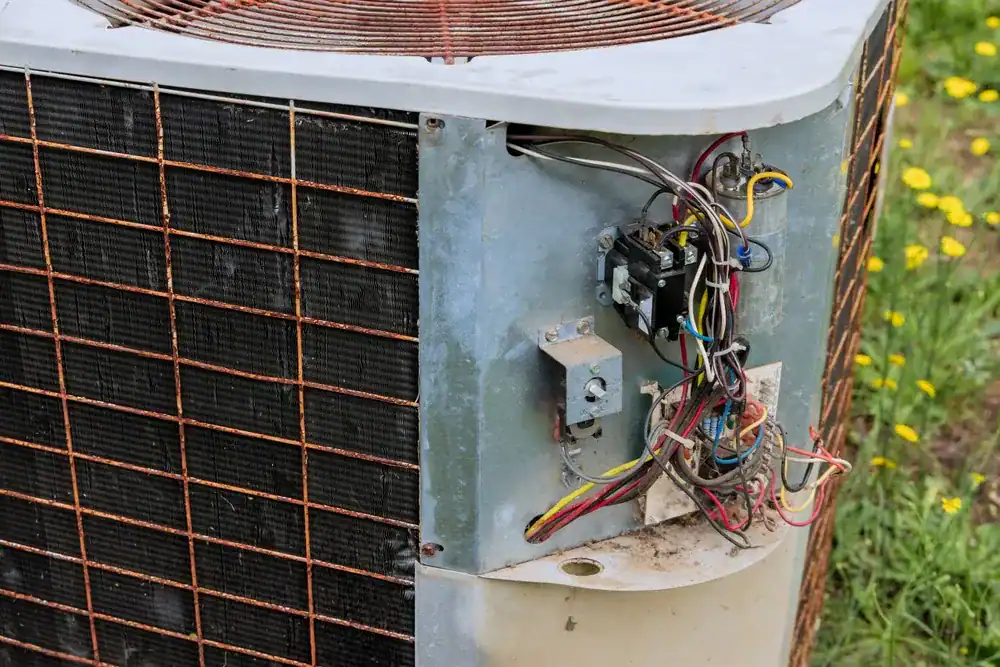
Nassau County’s geography creates HVAC conditions that most homeowners don’t think about until something goes wrong. The proximity to the Atlantic Ocean and Long Island Sound means outdoor condenser units here are exposed to salt-laden air year-round. That salt accelerates corrosion on coils, electrical contacts, and the cabinet itself — faster than you’d see in an inland market.
A system that might run fine for 18 years in a drier climate can show significant wear in 12 or 13 years here if it’s not being maintained properly. The humidity compounds this. Long Island summers are hot and sticky, and AC systems in this climate run longer and harder than systems in drier parts of the country. Extended runtimes put more stress on capacitors and contactors — two components that fail more often than most homeowners realize, and that a good maintenance visit will catch before they leave you without cooling on a 90-degree day.
Then there’s the housing stock. A large portion of Nassau County homes were built between the 1940s and 1970s. Many of them have ductwork that was sized for smaller, older systems — and when a newer, more powerful unit gets installed without addressing the ductwork, you end up with comfort problems that no amount of maintenance will fix. A proper assessment looks at the full picture, not just the equipment itself.
This is why annual air conditioner maintenance in Nassau County isn’t just a nice-to-have. It’s the difference between catching a $200 capacitor issue in April and paying for an emergency compressor call in July — or worse, discovering that a system that seemed fine was actually running at 20 to 30 percent reduced efficiency for the past two seasons.
How Often Should You Schedule AC Maintenance in Nassau County, NY?
Once a year is the standard recommendation, and spring is the right time to do it — before the cooling season starts and before every HVAC company in Nassau County is booked solid with emergency calls. Getting your system serviced in March, April, or early May means a technician can find and fix small problems while you still have time to address them calmly, not urgently.
What surprises a lot of homeowners is how quickly a system can go from “seems fine” to “not fine.” Only about 42 percent of homeowners perform annual HVAC maintenance — which means the majority of AC systems in any given Nassau County neighborhood are running in a degraded state. They’re not necessarily broken. They’re just not working as well as they should be, and the homeowner has no way of knowing that until the bill goes up or the system gives out.
If you’ve just bought a home in Nassau County and you’re not sure when the system was last serviced, that’s reason enough to schedule a visit. Inherited HVAC systems are one of the most common sources of expensive surprises for new homeowners, and a thorough inspection will tell you exactly what you’re working with — its age, its condition, and whether it’s worth maintaining or approaching the point where replacement makes more sense.
One other thing worth knowing: HVAC systems account for roughly 48 percent of the average household energy bill. That’s not a small number. A system that’s running even slightly below peak efficiency is costing you money every month, quietly, in a way that doesn’t show up as an obvious problem until someone actually measures it.
When to Stop Repairing and Start Thinking About HVAC Replacement
Maintenance keeps a good system running well. But there’s a point where a system has aged past the point where maintenance is the right answer — and continuing to repair it becomes more expensive than replacing it. Knowing where that line is can save you from throwing money at a system that’s already on its way out.
The clearest signal is age. Air conditioners typically last 15 to 20 years with proper maintenance. Once a system crosses the 10-year mark, the calculus on repairs starts to shift. That doesn’t mean a 12-year-old system automatically needs to go — but it does mean that a $600 repair on a 14-year-old system deserves a harder look than the same repair on a 6-year-old one.
The $5,000 Rule: A Simple Way to Decide Between Repair and Replacement
One of the most useful frameworks for this decision is what the HVAC industry calls the $5,000 rule. Take the age of your system in years and multiply it by the cost of the repair being quoted. If that number exceeds $5,000, replacement is generally the smarter financial move. If it comes in under $5,000, repair usually makes sense — assuming the system is otherwise in decent shape.
For example: if your system is 12 years old and you’re looking at a $500 repair, that’s $6,000 by the formula — a signal that you’re in replacement territory. If it’s 8 years old and the repair is $300, that’s $2,400 — worth fixing and maintaining.
In Nassau County, this calculation takes on a little extra weight. Home values here run high — median values in communities like Plainview sit around $600,000, and that’s not unusual across much of the county. A home with an aging, unreliable HVAC system is a harder sell, and 55 percent of home buyers consider HVAC age a major factor in their purchasing decision. Energy-efficient HVAC upgrades can also add up to 8 percent to a home’s resale value.
So the replacement decision isn’t just about comfort — it’s a legitimate financial consideration for Nassau County homeowners who may be selling in the next few years. If your system still uses R-22 refrigerant, that’s another factor. R-22 has been phased out, which means it’s expensive and increasingly hard to source. A system that needs a refrigerant recharge and runs on R-22 is one where the math on repair almost never works out in your favor.
What a Legitimate Upgrade Looks Like for a Nassau County, NY Home
If replacement is the right call, the next question is what to replace it with — and that decision matters more than most people realize. A system that’s improperly sized for your home, regardless of how efficient it is on paper, will underperform and wear out faster than it should. This is why a proper installation starts with a Manual J load calculation — a detailed assessment of your home’s square footage, insulation, window placement, and layout that determines the right system size. Skipping that step is one of the most common ways a new system ends up disappointing a homeowner.
For Nassau County homeowners, there are a few upgrade paths worth knowing about. High-efficiency central air systems — like the American Standard systems we install, which reach up to 22.0 SEER2 efficiency — can deliver estimated energy savings of $840 or more per year compared to older, lower-efficiency equipment, and they come backed by a 10-Year Limited Warranty.
For homes where ductwork is a limiting factor, ductless mini-split systems are worth a serious look. They sidestep the ductwork problem entirely and allow for zone-by-zone temperature control, which is particularly useful in older Nassau County homes where the existing duct layout was never ideal to begin with.
On the financial side, Nassau County homeowners have access to incentives that make upgrading more affordable than many people expect. PSEG Long Island — the primary utility serving the county — offers rebates ranging from $200 to $800 per unit on qualifying mini-split systems when installed by a participating contractor. Federal tax credits under the Inflation Reduction Act add up to $2,000 for qualifying heat pump installations on top of that. These aren’t small numbers, and they’re worth factoring into the replacement decision before assuming the upfront cost is out of reach.
We offer free estimates on new systems, which includes a full assessment of what your home actually needs — not just a quote for the equipment. Financing is also available for homeowners who want to move forward without paying the full cost upfront.
Making the Right AC Decision Before Nassau County Summer Arrives
The homeowners who handle this well aren’t the ones who know the most about HVAC. They’re the ones who don’t wait until they’re forced into a decision. Getting your system looked at in the spring — before the heat hits and before contractor schedules fill up — is what keeps you in control of whether you maintain, upgrade, or replace.
If your system is relatively young and hasn’t been serviced in a while, a thorough tune-up is almost certainly the right first move. If it’s older, running less efficiently than it used to, or facing a repair that’s starting to feel like it’s not worth it, a professional assessment will give you a clear picture of where things stand and what makes sense financially.
We’ve been serving Nassau County homeowners for over eight years, with NATE-certified, EPA-certified technicians and a 5.0-star rating built on 142+ verified reviews. If you’re not sure where your system stands, we’re a straightforward call or message away.