

Here’s what matters when your HVAC system fails: how fast someone answers, whether they know what they’re doing, and if they’ll be straight with you about cost. Everything else is noise.
You’re dealing with Long Island humidity that makes your AC work overtime. Winter temps that drop below 16°F. A coastal climate that’s harder on equipment than most techs realize. That’s not a sales pitch—it’s your reality, and it’s why generic HVAC maintenance doesn’t cut it here.
When we handle your air conditioning repair or central AC installation in Kenilworth, NY, the job gets done right the first time. Your energy bills stop climbing. Your system runs quieter. You’re not calling us back in three months because something else broke. That’s the difference between a quick fix and actually solving the problem.

First, you call or message us with the problem. We ask a few questions to understand what’s happening—not to upsell you, but to send the right tech with the right parts. If it’s an emergency, we move fast.
When we arrive, we diagnose the actual issue. Not what we think it might be, not what we hope it is—what’s actually wrong. You get a clear explanation of the problem and an upfront price before we touch anything. No surprises on the invoice.
Then we fix it. Whether it’s AC repair in Kenilworth, NY, a full central AC installation, or routine HVAC maintenance, we complete the work on schedule. We test everything before we leave. You get documentation of what we did and recommendations for keeping your system running efficiently. That’s it—no pressure, no gimmicks, just the work you hired us to do.

Ready to get started?
We install, repair, and maintain every type of residential and commercial HVAC system: central air conditioning, heat pumps, ductless mini-splits, and boilers. If it heats or cools your building, we work on it.
Nassau County’s climate is tough on HVAC equipment. Summer temps hit 82°F with humidity that makes your AC run constantly. Winters drop to 16°F, and your heating system can’t take a day off. That’s why our HVAC maintenance plans focus on catching problems before they become expensive emergencies—worn belts, refrigerant leaks, dirty coils that force your system to work twice as hard.
Energy efficiency matters here because your utility bills reflect every inefficient component. We prioritize properly sized equipment and smart thermostat integration when we’re doing installations. Over 50% of homeowners now want energy-efficient HVAC systems, and for good reason—air conditioning costs American homeowners roughly $29 billion annually. In Kenilworth, where your AC runs hard from May through September, an efficient system isn’t a luxury. It’s basic financial sense.
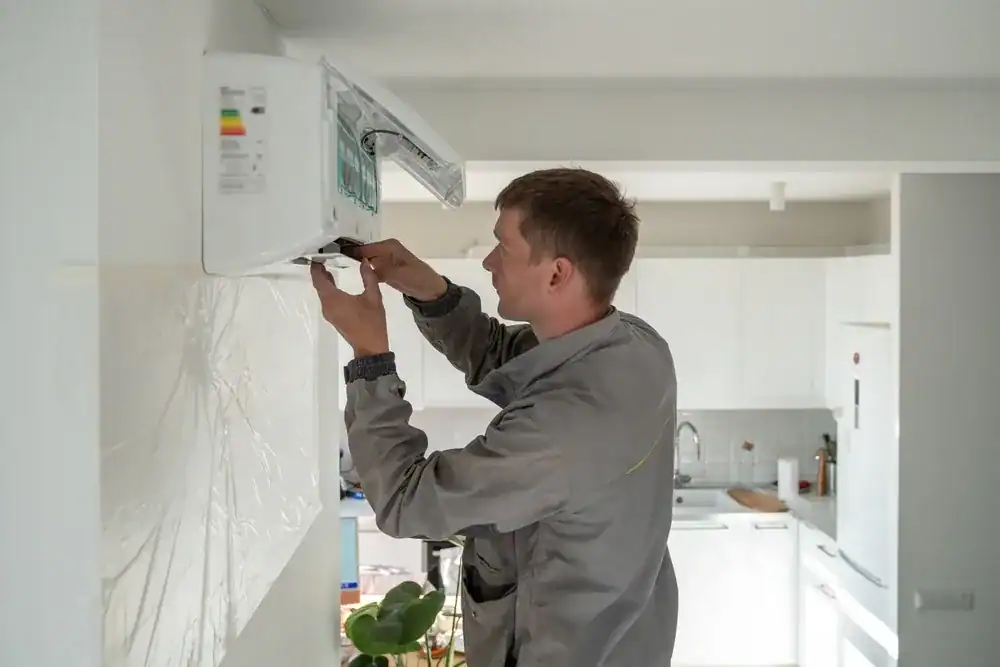
Twice a year—once before cooling season, once before heating season. That’s spring and fall for most Nassau County homeowners.
Here’s why that timing matters. Your AC is about to work nonstop through summer humidity, and your furnace or heat pump will run constantly once temperatures drop. Maintenance before those heavy-use periods catches the small problems—a failing capacitor, low refrigerant, a cracked heat exchanger—before they leave you without heating or cooling when you actually need it.
Long Island’s coastal environment accelerates wear on HVAC components. Salt air corrodes metal parts faster. Humidity creates more condensation, which means more opportunities for mold and drainage issues. A maintenance visit includes cleaning coils, checking refrigerant levels, testing electrical connections, and inspecting your ductwork—all the things that prevent a $150 tune-up from becoming a $3,000 replacement.
For a typical Kenilworth home, expect $5,000 to $12,000 depending on system size, efficiency rating, and whether your ductwork needs modification. That’s a wide range because your specific situation determines the actual cost.
A 1,200 square foot ranch needs less cooling capacity than a 2,500 square foot colonial. Higher SEER ratings (efficiency) cost more upfront but save you money monthly on energy bills—something worth considering when your AC runs from May through September here. If your existing ductwork is undersized, leaking, or poorly designed, fixing that during installation prevents you from paying to cool your attic instead of your living room.
We give you an exact price after seeing your home, measuring your space, and checking your current setup. No ballpark estimates that magically increase once we start working. The quote you get is the price you pay, and it includes everything: equipment, labor, permits, and cleanup.
If your system is under 10 years old and the repair costs less than half of replacement, fix it. If it’s over 15 years old and needs major repairs, replacement usually makes more financial sense.
Here’s the math that matters. A compressor replacement might run $1,500 to $2,500. If your AC unit is 7 years old and otherwise healthy, that repair buys you another 5-8 years of service. But if your 16-year-old system needs a new compressor, you’re putting $2,000 into equipment that’s already on borrowed time—and it’s still running at outdated efficiency levels that cost you extra every month.
Age isn’t the only factor. If you’re calling for repairs every season, if your energy bills keep climbing despite normal usage, or if some rooms never get comfortable, your system might be undersized or failing in ways that make replacement smarter than another patch job. We’ll tell you honestly which option makes sense for your situation and your budget.
Your system might run fine but work inefficiently—and that costs you money every single month without obvious symptoms. Dirty coils, low refrigerant, leaking ducts, and improper sizing all force your HVAC equipment to run longer to achieve the same temperature.
Nassau County homeowners spend roughly 12% of their annual energy budget on air conditioning alone. When your system works harder than it should, that percentage climbs fast. A refrigerant leak doesn’t stop your AC from cooling—it just makes the compressor run constantly to compensate. Ductwork leaks in your attic mean you’re paying to condition space nobody uses while your living room stays uncomfortable.
Sometimes the problem is the equipment itself. If your AC or furnace is 15+ years old, it’s running at efficiency standards from 2010. Newer systems use 20-30% less energy for the same output. A high energy bill might not mean something’s broken—it might mean you’re operating outdated equipment that costs you $50-100 extra monthly compared to a modern, properly sized system.
Ductless mini-split systems often work better than central air for older Kenilworth homes, especially if you don’t have existing ductwork or your ducts are in rough shape. They’re efficient, they give you room-by-room control, and installation doesn’t require tearing apart your walls.
Many older Nassau County homes were built before central AC was standard. Adding ductwork later means either sacrificing closet space, dealing with bulky soffits, or accepting undersized ducts that restrict airflow. Mini-splits avoid that entirely—small refrigerant lines run through a 3-inch hole in your wall, connecting outdoor units to indoor air handlers in each room you want to condition.
The other advantage for older homes: zone control. Your second floor is always hotter than your first floor because heat rises and insulation standards were different when your house was built. With mini-splits, you set different temperatures for different areas instead of overcooling your first floor trying to make your bedrooms comfortable. That saves energy and solves comfort problems that central systems struggle with in homes that weren’t designed for them.
Yes. HVAC emergencies don’t wait for business hours, and neither do we. When your heat fails in January or your AC dies during a heatwave, you need someone who answers the phone and actually shows up.
Emergency service means we prioritize your call and get a technician to your Kenilworth home as quickly as possible—usually same-day for true emergencies. We carry common parts on our trucks so we can often complete repairs on the first visit instead of making you wait days for an order to arrive while you’re uncomfortable in your own home.
Here’s what qualifies as an emergency: no heat when it’s below freezing, no AC when temperatures are dangerous for kids or elderly family members, gas smells, strange burning odors, or water leaking from your HVAC system. If you’re not sure whether your situation counts as urgent, call us anyway. We’d rather talk you through a simple fix over the phone than have you wait until Monday when the problem gets worse.
Local Resources
Other Services we provide in Kenilworth
