
You stop waking up sweating in July because your AC quit overnight. You stop hearing that rattling sound every time the heat kicks on. Your energy bills level out instead of spiking every month for no clear reason.
That’s what proper HVAC maintenance in East Hills, NY gets you. Not just a working system, but one that’s sized right, running efficiently, and catching small problems before they turn into expensive emergencies.
Most homeowners in Nassau County don’t realize their system is struggling until it fails completely. By then, you’re looking at emergency rates, limited availability, and zero negotiating power. Regular maintenance and honest assessments prevent that scenario entirely.
When your heating and cooling work the way they should, your home feels consistent. No cold spots in the bedroom. No fighting over the thermostat. Just steady comfort that doesn’t cost a fortune to maintain.
We’ve been handling residential and commercial HVAC work across Nassau County since 2016. We’re based in Lynbrook, and we’ve seen every type of system, every common failure point, and every seasonal issue that hits homes in East Hills, NY.
Our BBB A+ rating isn’t decorative. It reflects how we operate: clear pricing, certified technicians, and work that gets done when we say it will. We’re not the biggest HVAC company in Nassau County, and we’re not trying to be.
What matters more is that when you call, you get someone who knows the difference between a repair that buys you two more years and one that’s just delaying the inevitable. That’s the kind of honesty that keeps clients coming back.
First, we actually listen. You tell us what’s going on—weird noises, high bills, uneven temperatures, whatever—and we ask enough questions to understand the real issue before we ever show up.
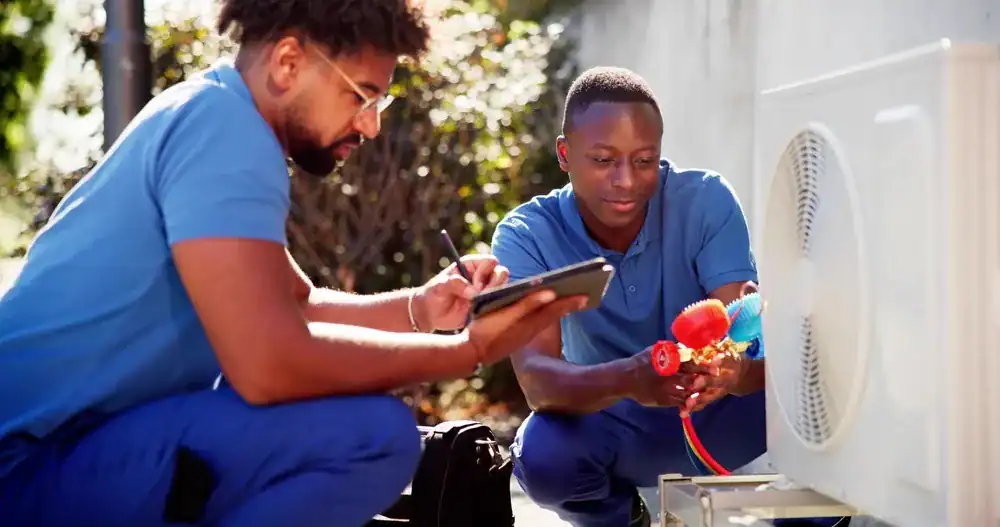
When we arrive, our certified technicians run a full diagnostic. Not just the obvious stuff, but airflow, refrigerant levels, ductwork integrity, and whether your system is even the right size for your space. Plenty of homes in East Hills, NY are running oversized or undersized units that’ll never perform right no matter how many repairs you throw at them.
Then we explain what we found in plain terms. If it’s a simple fix, we tell you. If you’re better off replacing the system, we tell you that too, with numbers that actually make sense. No scare tactics, no upselling equipment you don’t need.
Once you approve the work, we handle it on the timeline we promised. Installations get done right the first time, with proper permits and inspections. Repairs come with clear explanations of what we did and why. And if something doesn’t go as planned, we own it and make it right.
Ready to get started?
Twice a year is the standard—once before cooling season and once before heating season. That gives you the best chance of catching issues before they become emergencies.
Spring maintenance focuses on your AC: checking refrigerant, cleaning coils, testing the compressor, and making sure airflow is where it should be. Fall maintenance covers your heating system: inspecting the heat exchanger, testing ignition, checking gas connections if applicable, and verifying safety controls work properly.
If you have a newer system that’s still under warranty, regular maintenance is usually required to keep that warranty valid. Even if it’s not, the cost of two tune-ups per year is a fraction of what you’d pay for an emergency repair or premature replacement. Most HVAC systems in Nassau County last 15-20 years with proper care, but that timeline drops fast if you skip maintenance.
For a typical single-family home in East Hills, NY, you’re looking at $5,000 to $10,000 for a complete central AC installation, depending on system size, efficiency rating, and any ductwork modifications needed.
Higher-efficiency units cost more upfront but save you on energy bills long-term. A 16 SEER system is the current standard, but if you’re planning to stay in your home for years, an 18 or 20 SEER system pays for itself through lower monthly costs. The federal tax credit covers 30% of installation costs for qualifying high-efficiency systems, which can bring your out-of-pocket expense down significantly.
If your existing ductwork is in rough shape—leaks, poor insulation, undersized runs—that’ll add to the project cost. But ignoring duct issues means your new system will underperform from day one. We assess everything during the estimate so there are no surprises once work starts.
If your system is under 10 years old and the repair costs less than half the price of replacement, repair usually makes sense. If it’s over 15 years old and you’re looking at a major component failure—compressor, heat exchanger, evaporator coil—replacement is often the smarter move.
Here’s why: older systems use R-22 refrigerant, which is being phased out and getting expensive. Efficiency standards have also improved dramatically, so even a mid-grade new system will outperform an older high-efficiency model. And if you’re repairing something major now, there’s a good chance another expensive failure is 12-24 months away.
We run the numbers with you. If replacement makes sense, we’ll show you what your energy savings would look like and how long it takes to break even. If repair gets you several more good years, we’ll tell you that instead. The goal is making a decision you won’t regret next summer when temperatures hit 90.
Your system might be running, but that doesn’t mean it’s running efficiently. Dirty coils, low refrigerant, clogged filters, and duct leaks all force your HVAC system to work harder and run longer to maintain temperature.
In Nassau County, we see this constantly with oversized systems. A contractor installed a unit that’s too powerful for the space, so it cools or heats quickly but shuts off before completing a full cycle. That’s called short-cycling, and it’s terrible for efficiency. Your system never runs long enough to dehumidify properly in summer, and it wears out components faster because of constant stop-start operation.
Thermostat placement matters too. If yours is near a window, door, or heat source, it’s getting false readings and telling your system to run when it doesn’t need to. Programmable or smart thermostats help by adjusting temperatures based on when you’re actually home, but only if they’re installed in the right spot and programmed correctly.
Central air conditioning only cools. A heat pump cools in summer and heats in winter, which means it replaces both your AC and your furnace or boiler.
Heat pumps work by moving heat rather than generating it, which makes them extremely efficient in moderate climates. They pull heat out of your home in summer, just like regular AC. In winter, they extract heat from outdoor air and move it inside. That sounds impossible when it’s 20 degrees out, but modern cold-climate heat pumps work efficiently down to -15°F or lower.
For homes in Nassau County that currently use oil heat or electric baseboard, switching to a heat pump can cut heating costs by 30-50%. If you have natural gas, the savings are smaller but still significant. Heat pumps also qualify for federal tax credits and sometimes state or utility rebates, which offset the higher upfront cost. The main downside is that heat pumps require a backup heating source for extreme cold snaps, though that’s rare in this area.
You don’t need one, but a programmable or smart thermostat can cut your energy costs by 10-15% without any other changes to your system.
Old manual thermostats keep your home at the same temperature 24/7, even when you’re asleep or at work. Programmable thermostats let you set schedules so your system isn’t running full blast when nobody’s home. Smart thermostats go further by learning your patterns, adjusting for weather changes, and letting you control everything from your phone.
The bigger benefit is diagnostics. Smart thermostats track runtime, cycle frequency, and temperature patterns. If something’s off—like your system running twice as long as it should to hit target temperature—you’ll know before it turns into a breakdown. Some models even alert you when it’s time to change filters or schedule maintenance.
Installation is straightforward if your existing wiring is compatible. If it’s not, adding a common wire or using an adapter usually solves it. For most homes in East Hills, NY, the thermostat upgrade pays for itself in energy savings within two years.
Local Resources
Other Services we provide in East Hills
