You called an HVAC technician, paid for a repair, and a few weeks later the problem came back. Sound familiar? You’re not alone — and it’s not always bad luck. More often, it’s a diagnostic shortcut that never found the actual root cause.
HVAC systems fail in ways that look identical on the surface but have completely different causes underneath. Warm air blowing from your vents could mean a refrigerant leak, a failing compressor, a dirty coil, or a thermostat that’s lost calibration. A technician who doesn’t work through each possibility methodically is really just making an educated guess.
Here’s what accurate HVAC diagnosis actually involves — and why it matters more than most homeowners realize.
What a Proper HVAC Repair Service Diagnosis Actually Looks Like
A thorough diagnostic isn’t a five-minute visual scan. It’s a step-by-step process that starts with what we can see and hear, then moves into instrument-verified testing — checking electrical connections, refrigerant levels, airflow, coil condition, thermostat calibration, and safety circuits before any part gets replaced.
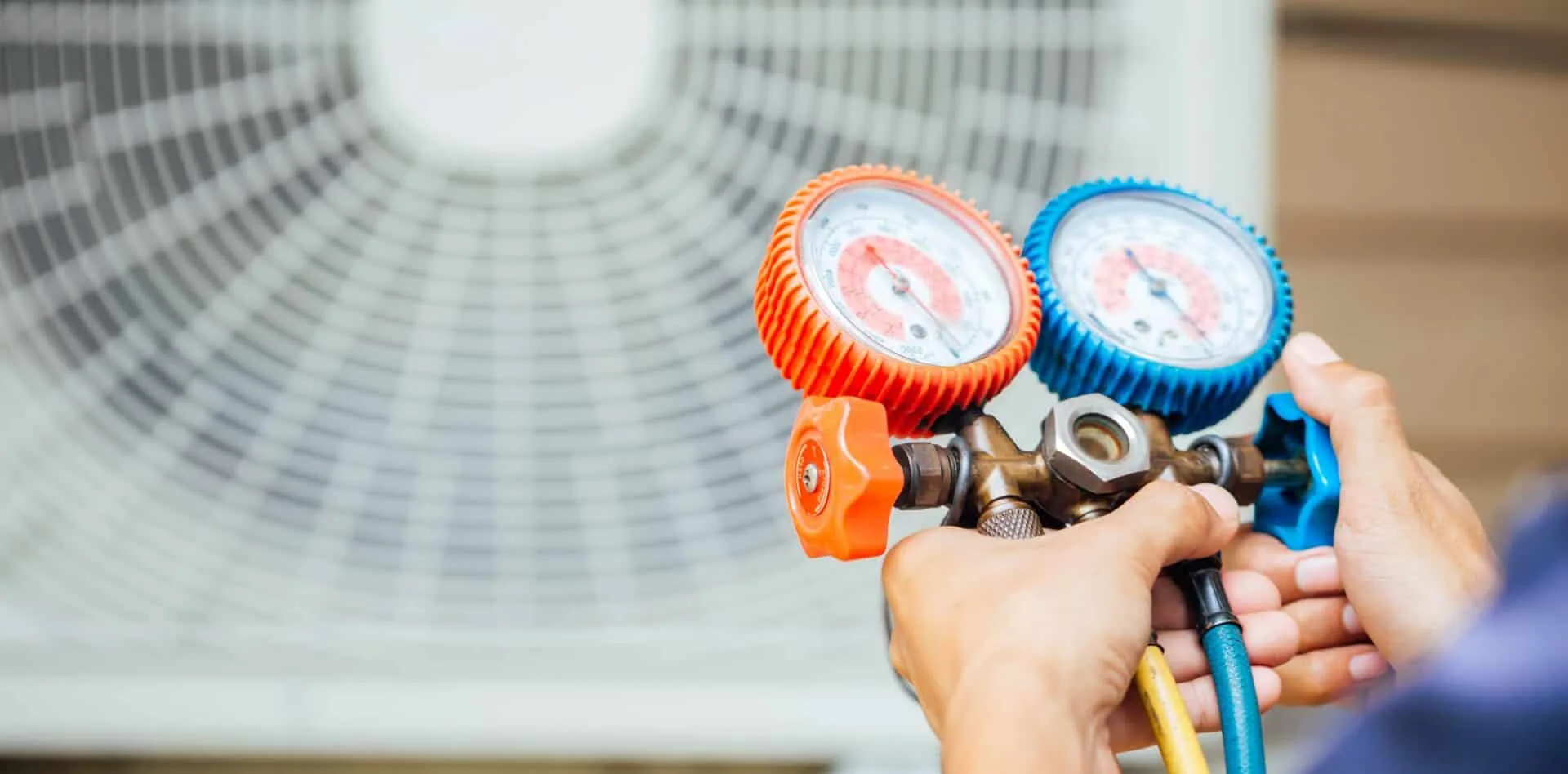
The tools matter here. Manifold gauges measure refrigerant pressure. A multimeter checks voltage at key components. A leak detector confirms whether refrigerant is escaping and where. Without these, we’re working from assumption, not data — and assumptions get expensive when they’re wrong.
The goal isn’t just to find something broken. It’s to find the thing that caused the breakdown, so the repair actually holds.
Why the Same Symptom Can Have Four Different Causes
Short cycling — when your system turns on and off every few minutes — is one of the most commonly misdiagnosed HVAC symptoms. Homeowners Google it, find one explanation, and assume that’s the answer. But short cycling can be caused by a faulty thermostat, an oversized system, low refrigerant, or a failing compressor. Those are four completely different problems that require four completely different repairs.
A technician who walks in, hears “it keeps turning on and off,” and immediately checks the refrigerant without running a full diagnostic isn’t being thorough — they’re pattern-matching. That might work sometimes. But when it doesn’t, you end up paying for a refrigerant top-off when the real issue was a thermostat that’s been reading temperatures wrong for months.
This matters even more in Nassau County, where a lot of the housing stock dates back to the 1950s and 1960s. Older homes often have systems that have been repaired multiple times, ductwork that’s been patched, and electrical panels that weren’t built with modern HVAC loads in mind. Diagnosing a system in a 1958 Cape Cod in Rockville Centre, NY is a different job than diagnosing a newer build in Merrick, NY. We account for the home’s history, not just the symptom in front of us.
The same logic applies to warm air blowing from the vents, poor airflow, or a system that simply won’t start. Each of those symptoms has a family of possible causes, and the only way to know which one you’re dealing with is to test — not assume. A low refrigerant reading doesn’t tell you why refrigerant is low. It could be a slow leak that’s been developing for two years, or it could be a fitting that wasn’t properly sealed during a previous repair. Topping off the refrigerant without finding and fixing the leak is a temporary fix. You’ll be making another call in six months.
The point isn’t that technicians are cutting corners on purpose. It’s that a rushed diagnostic — one that stops as soon as something plausible turns up — leaves real problems buried. And buried problems come back.
How to Tell If Your HVAC Technician Is Being Thorough
You don’t need to be an HVAC expert to recognize whether a technician is doing the job properly. There are a few things you can watch for.
A thorough technician will ask questions before they start — when did the problem begin, has this happened before, has any recent work been done on the system. We inspect the system before we open anything up, checking the outdoor condenser unit, the air handler or furnace, the thermostat, and the ductwork access points. We use instruments, not just our eyes. And before we recommend a repair, we can explain what we found and why we believe it’s the root cause — not just what part we want to replace.
Contrast that with a technician who arrives, listens to your description for two minutes, and immediately reaches for a part. That’s not diagnosis. That’s a guess dressed up as experience.
The credentials behind a technician also tell you something real. NATE certification — North American Technician Excellence — requires passing standardized knowledge exams that go well beyond what a basic license covers. EPA Section 608 certification is a federal requirement for anyone who handles refrigerants, meaning a technician without it legally cannot work on the part of your system most likely to need attention. These aren’t marketing badges. They’re indicators that the person working on your system has been tested on what they claim to know.
It’s also worth understanding the difference between a quick service call and a proper diagnostic. If a technician is in and out in under 30 minutes on a system that’s been behaving erratically, that timeline alone should raise a question. A full diagnostic — one that checks electrical connections, refrigerant charge, airflow, coil condition, and safety circuits — takes time. Not hours, but enough time to actually work through the system rather than skim it.
Nassau County homeowners near the coast, particularly in communities like Long Beach, NY or Atlantic Beach, NY, face an additional layer of complexity: salt air corrosion. Outdoor condenser units in these areas degrade faster than those further inland, and the corrosion can affect electrical components and refrigerant lines in ways that aren’t immediately visible. We know to look for this — and we ask where your home is located — because it’s a contributing factor that many technicians miss entirely.
Emergency HVAC Repair in Nassau County: Speed Matters, But Accuracy Matters More
When your heat stops working on a January night in Nassau County — with temperatures dropping into the mid-20s — you need someone fast. That’s real. But fast and accurate aren’t mutually exclusive, and a technician who rushes a diagnosis to clear the call quickly isn’t doing you any favors.
True emergency HVAC repair means a licensed technician arrives promptly, works through the problem methodically even under pressure, and fixes the actual issue — not the most convenient one. We offer real 24/7 emergency service for nights, weekends, and holidays throughout Nassau County. When you call 516-646-2260, you’re reaching us directly — not an answering service.
Residential AC Repair in Nassau County: What’s Different About Your Home
Residential AC repair isn’t one-size-fits-all, and Nassau County homes have specific characteristics that affect how HVAC systems are diagnosed and repaired.
The county’s proximity to the Atlantic Ocean and Long Island Sound creates a humid climate that puts real stress on air conditioning systems. High humidity accelerates evaporator coil degradation, clogs condensate drains faster, and creates conditions where mold can develop in ductwork — especially in homes that aren’t running their systems consistently. These aren’t hypothetical risks. They’re the kinds of issues we see regularly in homes across Freeport, NY, Baldwin, NY, and the waterfront communities along the South Shore.
Older homes add another layer. A colonial in Garden City, NY or a split-level in Valley Stream, NY built in the 1960s may have ductwork that was never sized for modern HVAC equipment, electrical panels with limited capacity, and systems that have been serviced by multiple companies over the decades. Each of those factors affects how a problem should be diagnosed. We don’t treat every home the same — we run different checklists depending on the home’s age, layout, and history — because that’s how we catch things other technicians miss.
This is also why proper system sizing matters so much when a repair leads to a replacement conversation. An oversized system short cycles. An undersized system runs constantly and never quite reaches the set temperature. Neither scenario is comfortable, and both cause premature wear. We perform Manual J load calculations during our free in-home estimates — a calculation that accounts for your home’s square footage, insulation, window count, ceiling height, and other factors — to make sure any new equipment we recommend is actually right for your specific home, not just the closest standard size.
Financing is available through Synchrony Financial for homeowners who need work done but want flexibility on timing the expense. The goal is to make sure cost doesn’t push a necessary repair or replacement down the road until the problem gets worse.
AC Repair on Long Island: Common Questions Nassau County Homeowners Ask
A few questions come up regularly when Nassau County homeowners are trying to figure out whether their HVAC system needs a repair, a tune-up, or a full replacement.
**Is it worth repairing an older system?** The general industry guidance is that if your system is over 10 to 15 years old and the repair cost exceeds half the price of a new system, replacement is usually the better long-term investment. Newer systems are more efficient, come with manufacturer warranties, and don’t carry the accumulated wear of an older unit. But that math only works if the diagnosis is accurate in the first place. An inflated repair estimate on a system that actually has years of life left in it can push a homeowner toward a replacement they didn’t need — which is why we always explain what we find before recommending next steps.
**Why did my refrigerant run low?** Low refrigerant is almost always the result of a leak somewhere in the system. Simply adding refrigerant without finding and sealing the leak is a short-term fix. The refrigerant will escape again, the system will underperform again, and you’ll be back to square one. A proper repair addresses the leak itself — not just the symptom it caused. In Nassau County’s humid climate, we often find that condensate drain issues compound refrigerant problems, so we check both.
**Why have my energy bills climbed?** If your bills have jumped noticeably without a change in how you’re using the system, something is likely wrong. A system running with a partial refrigerant charge, a dirty coil, or a failing component has to work harder to reach the same output — and that extra effort shows up on your PSEG Long Island bill. Catching and correcting these issues early usually costs less than waiting until the system fails entirely.
**Does a DIY repair void my warranty?** In most cases, yes. Many HVAC manufacturers require that all service and repairs be performed by licensed professionals to maintain warranty coverage. Attempting a DIY fix — even a minor one — can leave you responsible for future repair costs that would otherwise have been covered. It’s worth knowing before you reach for a YouTube tutorial.
We’re NATE-certified, EPA certified, BBB accredited with an A+ rating, and we’ve built our reputation over more than eight years serving Nassau County homeowners. That’s not a credential list for its own sake — it’s the reason you can trust that when we tell you what’s wrong with your system, we’ve actually checked.
How to Choose an HVAC Repair Service You Can Actually Trust
The right HVAC repair service doesn’t just show up fast — it finds the real problem, explains it clearly, and fixes it in a way that holds. That standard isn’t complicated, but it’s not universal either.
If you’re in Nassau County and your system is acting up — whether it’s a mid-summer AC failure, a furnace that won’t fire up in January, or a system that’s been quietly underperforming for months — the most important thing you can do is make sure whoever you call is actually diagnosing the problem, not just the symptom.
COOL BROS CORP is based in Lynbrook, NY and serves homeowners throughout Nassau County. If you have questions about your system or want to talk through what you’re seeing, we’re here — day or night. Call 516-646-2260.