You’re hot, your house isn’t cooling down, and someone — a tech, a neighbor, a quick Google search — has told you the compressor might be the problem. Now you’re staring at a potential repair bill that could run anywhere from a few hundred dollars to several thousand, and you’re not sure whether fixing it even makes sense or whether you’d be better off putting that money toward a new system.
That’s exactly the kind of decision this page is built for. We’ll walk you through what’s actually happening when a compressor fails, what it costs to fix or replace one here in Nassau County, and the one question most homeowners forget to ask before agreeing to anything.
Air Conditioner Compressor Replacement Cost in Nassau County
Let’s start with the number everyone wants. For a full compressor replacement in Nassau County — parts, labor, refrigerant recharge — expect to pay somewhere between $1,200 and $2,500 depending on your system size, age, and the refrigerant it runs on.
That range sits higher than what you’ll see quoted on national cost guides, and that’s not a mistake. Long Island labor rates and the general cost of doing business here push HVAC pricing above the national average. A quote that looks high compared to what you read online may still be completely fair for this market.
For larger systems or more complex installs, costs can climb toward $3,500. And if your system runs on R-410A refrigerant — which most residential systems installed before 2025 do — that number may be higher than you’d expect for a reason that has nothing to do with your contractor.
What You’re Actually Paying For in a Compressor Replacement
A compressor replacement isn’t just swapping one part for another. When it’s done right, the job includes removing the failed compressor, installing a new one, replacing the filter drier, pulling a deep vacuum on the system to remove moisture, and recharging the refrigerant to the factory-specified weight.
Skip any of those steps and you risk contaminating the new compressor or voiding the warranty on the part you just paid for.
The parts themselves vary by system size. A 1.5-ton unit takes a smaller, less expensive compressor than a 3-ton or 5-ton system. Labor typically runs one to several hours depending on system accessibility and how straightforward the job is. Then there’s the refrigerant — and this is where 2025 changes everything for Nassau County homeowners.
As of January 1, 2025, manufacturers can no longer produce new R-410A refrigerant equipment. That doesn’t mean your system is illegal or needs to be replaced immediately — but it does mean the refrigerant used to recharge your existing system has gotten significantly more expensive. Cylinders that cost $90 to $150 a few years ago are now running $250 to $500 or more.
If your compressor replacement requires a full recharge — which it often does — that refrigerant cost is now a meaningful line item in your bill. It’s not a contractor markup. It’s the market. This is one of the clearest examples of why the repair-vs-replace math has shifted in 2025. A compressor repair that would have been straightforwardly worth it two years ago may now sit uncomfortably close to the cost of a new system — especially if your unit is already 10 or more years old.
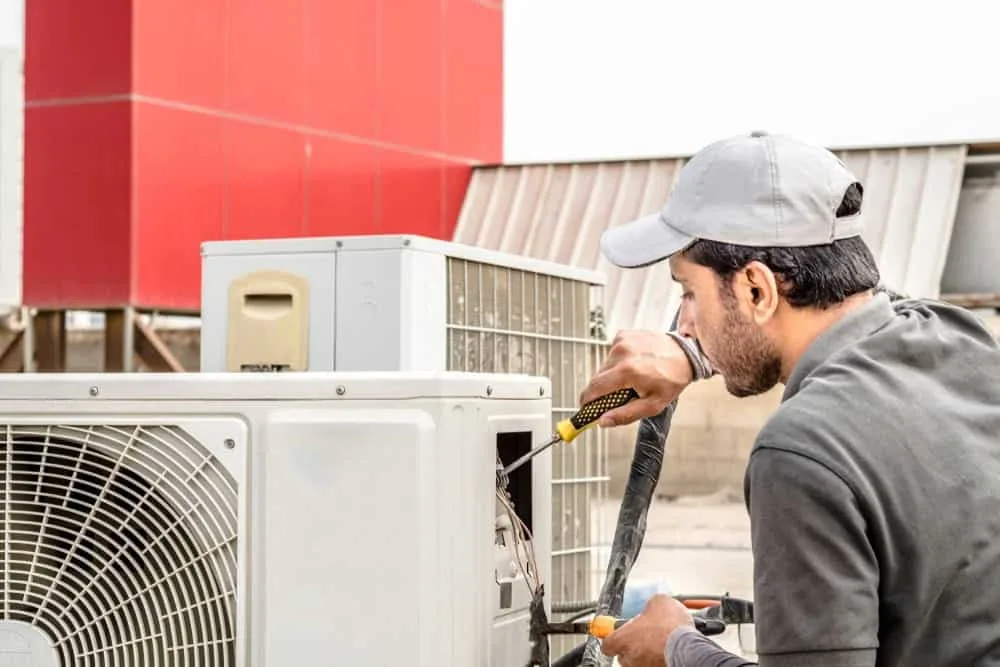
A proper diagnostic visit, which typically runs $80 to $200, is always worth it before you commit to anything. We’ll check your capacitors, electrical connections, and refrigerant pressures before recommending a compressor replacement. That matters more than it might sound, and we’ll explain why in the next section.
Should You Repair or Replace an AC Compressor? The 50% Rule Explained
The industry standard for making this call is something called the 50% rule: if the cost of repairing your compressor exceeds 50% of what a new system would cost, replacement is usually the smarter financial move. It’s a simple framework, but it holds up well in practice — especially when you factor in system age.
Most AC compressors last 10 to 15 years. If your system is under 10 years old and in otherwise good shape, a compressor replacement is often worth doing. You’re extending the life of a system that still has real years left in it.
But if your system is 12, 14, or 15 years old and the compressor has failed, you’re making a significant investment in equipment that may need another major repair within a few years anyway. Here’s how that math plays out in Nassau County terms. Full system replacement here tends to run significantly more than the national average, but a new American Standard system with a 10-year limited warranty and AccuComfort variable-speed technology is a fundamentally different product than the aging unit it’s replacing.
It runs more efficiently, costs less to operate month to month, and comes with warranty coverage that protects you going forward. A compressor repair on a 14-year-old system has none of those things.
The honest answer is that there’s no universal right call — it depends on your system’s age, its overall condition, and the specific repair cost you’ve been quoted. What we’d encourage you to push back on is any contractor who gives you a compressor replacement recommendation without first ruling out a much cheaper fix. Which brings us to the part most homeowners don’t know to ask about.
AC Capacitor Replacement Cost vs. Compressor Replacement
This is probably the most important thing on this page. A failed capacitor — a small electrical component that helps your compressor start and run — can produce symptoms that look almost identical to a failed compressor.
Warm air coming out of the vents. The system won’t start. A clicking or humming sound from the outdoor unit. These are the exact same signs people associate with a dead compressor.
Capacitor replacement typically costs $150 to $400 for parts and labor. Compressor replacement costs $1,200 to $3,500. That’s a significant difference, and it’s one reason a thorough diagnostic matters so much.
How Do You Know If It’s the Capacitor or the Compressor?
You don’t — not without testing. And that’s exactly why the sequence of a proper diagnostic matters. A qualified technician should check the capacitor, the contactor, and the electrical connections before drawing any conclusions about the compressor itself.
Those components are cheap to test and cheap to replace. The compressor is neither.
If a technician shows up, spends ten minutes outside, and tells you the compressor is gone without explaining what else they checked, that’s worth asking about. Not because they’re necessarily wrong, but because the answer to “did you check the capacitor first?” should be immediate and clear. A technician who walks you through their diagnostic process — what they tested, what the readings showed, why they ruled out the cheaper fix — is giving you something valuable: confidence that the recommendation is real.
We check the straightforward stuff first. Every time. Not because it’s always the answer, but because it’s the right way to do the job and the right way to treat the person paying for it. Nassau County homeowners have enough to deal with in the middle of July without being handed a $2,000 repair bill for a problem that might have cost $300 to fix.
There’s also a scenario worth knowing about: sometimes a compressor that’s struggling to start can be helped by a hard start kit, which assists the motor on startup and can extend the compressor’s usable life. It’s not a permanent fix for a compressor that’s truly failed, but it’s another option we should be able to speak to before jumping straight to full replacement.
The broader point is that HVAC repair — done honestly — is a diagnostic process, not a sales pitch. The goal is to find the real problem, tell you what it costs to fix, and give you enough information to make a decision you’re comfortable with.
Why Nassau County HVAC Repair Is Different
Nassau County’s housing stock is one of the most relevant factors in this whole conversation. A huge portion of the homes here — the capes, ranches, and colonials built across Long Island from the late 1940s through the 1970s — are running HVAC systems that are well into their second decade.
When a compressor fails in one of those homes, the repair-vs-replace question isn’t abstract. It’s immediate and it has real financial stakes.
The climate makes it worse. Long Island summers are hot and humid, and that combination puts sustained strain on AC compressors in a way that drier inland markets don’t experience. A system that might last 15 years in a less demanding climate can wear out faster here. When you add the coastal humidity that forces your system to dehumidify as well as cool, you’re asking a lot from equipment that may already be aging.
Then there’s the regulatory side. Nassau County requires HVAC contractors to hold a Home Improvement Contractor license through the Nassau County Office of Consumer Affairs. Any technician handling refrigerant — which is central to any compressor repair or replacement — is required by federal law to hold EPA Section 608 certification. These aren’t just formalities. An unlicensed contractor working on your system can void your equipment warranty and create liability issues for you as the homeowner. It’s worth asking before anyone starts work.
We’re based in Lynbrook, right in the middle of the communities we serve — Rockville Centre, Valley Stream, Freeport, Massapequa, Garden City, and Great Neck. We know what the housing stock looks like here, we know what the summers feel like, and we know what a fair quote looks like for Nassau County. When a compressor fails at 7 PM on a Saturday in August, same-day and 24/7 emergency service isn’t a marketing line — it’s the only response that actually helps.
What to Do When Your AC Compressor Fails
Here’s the short version: don’t assume the compressor is gone until someone has checked the capacitor and the electrical components first. Get a proper diagnostic before agreeing to anything. And if the compressor does need to be replaced, use the 50% rule and your system’s age to decide whether repair or full replacement makes more financial sense — especially now that refrigerant costs have risen the way they have.
If your system is under 10 years old and in otherwise good shape, a compressor replacement is often the right call. If it’s pushing 12 to 15 years and the repair quote is climbing toward half the cost of a new system, replacement deserves a serious look — particularly with the financing options we offer through Wells Fargo and Synchrony.
COOL BROS CORP is available same-day and around the clock for exactly these situations. If you’re dealing with a compressor issue in Nassau County and want a straight answer about what’s actually wrong and what it’s going to cost, reach out to us and we’ll get someone out to take a look.